New
Loyalty Program Benchmark Report 2027: Per-industry statistics, self-assessment, and more!
Get the report

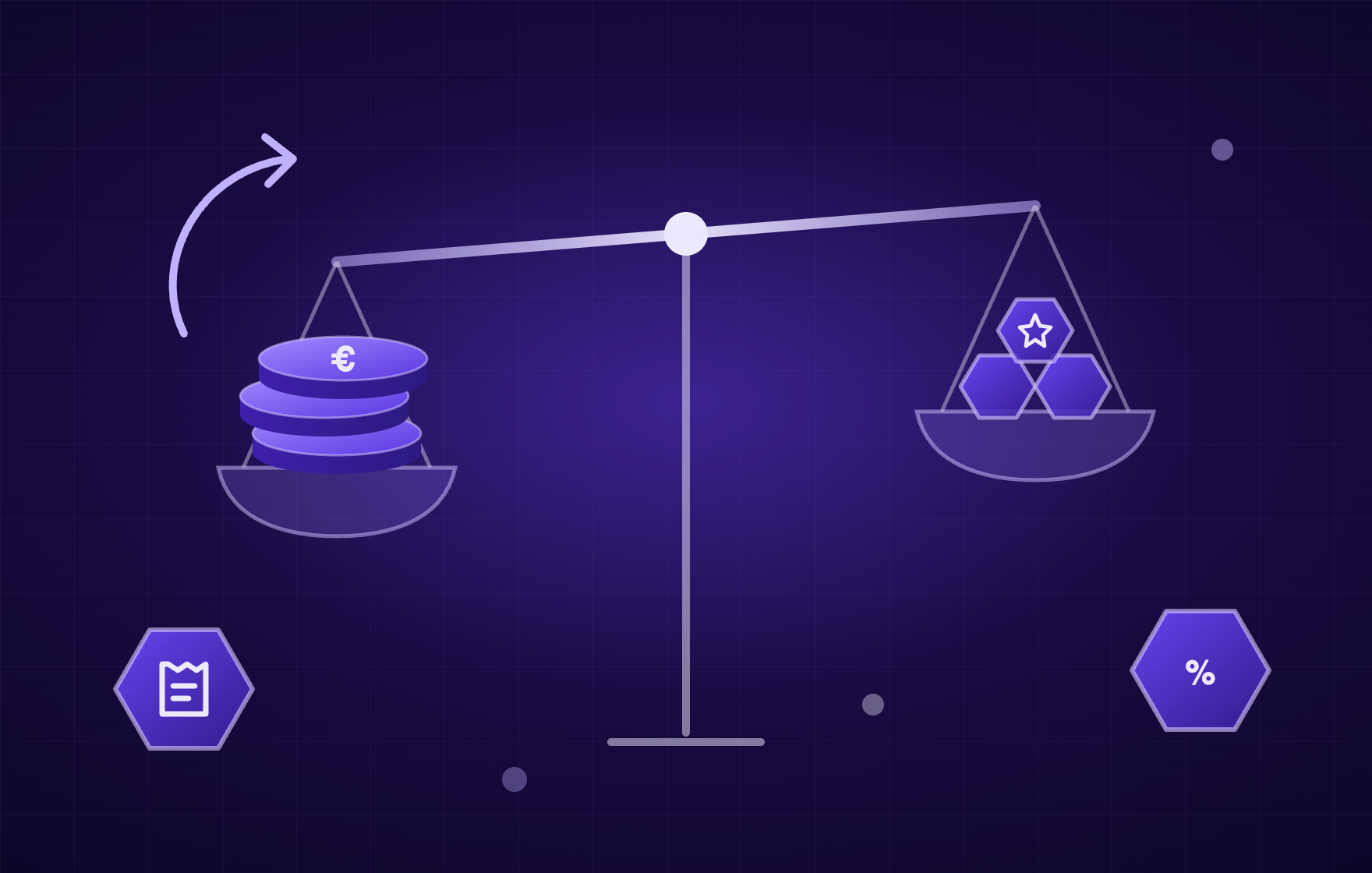
It works best when purchase frequency is high and the value is easy to grasp, but it struggles when margins are thin or most buyers only act on promotion. The right choice depends on your margin by category, how often customers return, and how much unredeemed balance your finance team will carry.
A cashback reward program returns a set share of each purchase to the member as spendable value, usually held in a cashback wallet and redeemed on a later order.
The published cashback rate sets the offer, but the effective reward rate, after returns, stacked promo codes, and category mix, sets what each order costs. How much of the wallet balance members spend depends on the redemption rate, which in turn decides how much unredeemed value finance must carry.
We recommend a wallet-based cashback reward program when category margins are even enough to support one rate and finance can carry the unredeemed balance as a liability, because the wallet gives members a reason to return. When margins vary widely or purchases are infrequent, points or tiers usually fit better.
A brand does not have to pick only one: Open Loyalty's cashback software runs cashback and points in the same program, and code-based rewards can sit next to the wallet through voucher management.
A brand-run cashback program is a ledger that moves a reward through four states, each triggered by an event from the commerce platform and each writing a distinct entry. The sequence below covers the brand-funded model, and card issuers and portals are treated separately afterwards.
The figures below are illustrative assumptions: a 5% rate, a 30-day pending period, a €10 redemption threshold, and an existing confirmed balance of €8.00.
Membership is the hardest part to design, because a channel partner is a company but rewards reach the individuals who quote, sell, and install. In a multi-level partner hierarchy (distributor to dealer to installer), one sale can touch three accounts, so the program needs linked company and individual accounts and a clear rule for who earns what.
Most manufacturers already run partner relationship management (PRM) software for onboarding, deal registration, and training records, so we recommend that the loyalty engine read from the PRM and partners keep one login.
Our B2B loyalty program guide covers generic buyer programs, and the channel version differs from them mainly in who holds the data.

Channel partners enroll as companies, but the people inside them, such as sales reps, counter staff, and installers, decide which product gets quoted, stocked, and fitted.
In a multi-level partner hierarchy (distributor to dealer to installer), we recommend one company account that holds the contract, tier, and budget, with individual sub-accounts that hold the points or spiffs (cash or non-cash bonuses paid to a salesperson for selling a specific product).
The best-fit mechanic for each partner type, based on our judgment and to be tested per market:
Co-op funds are marketing money a brand matches against a partner's purchases, and MDF is a budget the brand allocates for partner marketing. Both go to the company, never to an individual.
Match the mechanic to the partner's margin and to who makes the choice. Thin-margin distributors rarely value points against a rebate they can book directly, while installers choose the product on each job, so frequent, small, per-job rewards suit them better than annual tiers.
We define partner activation rate as the share of enrolled partners that register at least one qualifying sale in a period. Track it per segment, because a blended figure hides the installers who never log a job.
Segments overlap in practice: a distributor with a showroom behaves like a dealer, so assign the mechanic by how the partner behaves and ignore the contract label.
A channel loyalty program should reward sell-through first, meaning units that partners sell to end customers, confirmed by sell-through data. Sell-in, the units you ship to a partner, rewards stocking up, and a full partner warehouse says little about demand.
Add other behaviors only where a specific KPI gap exists. The table pairs each behavior with the gap that justifies it and the one KPI that shows whether it worked.
Check partner activation rate first after launch, measured over a window you set, such as 90 days, because a program that most partners never touch has no other results to report.
Run one baseline quarter on sell-through alone, then switch on a second behavior only where the data shows a gap, since every added behavior splits the reward budget and the partner's attention.
The one exception is a distributor that doesn't share sell-through data today. Reward the data sharing first, because without that feed you can't measure any other behavior.
Match the reward type to how each partner makes money: co-op funds and market development funds for the business, spiffs for the individual seller, and tiers to grow share of wallet.
Co-op funds are marketing money a partner accrues as a percentage of purchases, usually matched against its own ad spend. Market development funds (MDF) are a manufacturer-set budget released against an agreed marketing plan, and a spiff (sales performance incentive fund) is a cash or cash-equivalent payment to a salesperson for each unit sold.
How the rewards map to each partner:
The first failure mode is a tier cliff. When a rebate tier resets on January 1 and pays retroactively on all volume, a dealer sitting below the threshold in November has every reason to pull orders forward, and some dealers will divert units to other dealers or the gray market to cross the line. A rolling 12-month window avoids this, with marginal rates that apply only to units above each threshold.
The second failure mode is rewards that stop at the owner. If every reward credits the company account, the installer who specifies your product never sees it. Keep business rewards (co-op, MDF, rebates) on the company account and put spiffs and points on individual accounts nested beneath it, using a reward management system that supports parent and child accounts.
A spiff paid to an individual is generally taxable income, and gifts to individuals can raise anti-bribery questions, so set per-person caps and approval rules before launch.
Proof of sale is the evidence that a partner sold a specific product to an end customer, and a channel loyalty program pays out only after that evidence validates. Four methods dominate: invoice upload, serial-number scanning, point-of-sale (POS) feeds, and distributor sell-through data delivered by electronic data interchange (EDI) feeds or enterprise resource planning (ERP) integration.
The ratings below are our own judgment, with no benchmark data behind them.
Match the method to what a bad claim costs. Serial-number scanning fits high-value serialized goods such as inverters or power tools, because a serial that was never shipped to that partner's distributor fails validation. Invoice upload fits the long tail of small dealers who have no systems to integrate.
Distributors often treat sell-out data as commercially sensitive. When they do, pay on dealer-submitted invoices or serial scans, reconcile them against the sell-in invoices to that distributor that you already hold, and audit a sample each month. Then reward the distributor for sharing data, so the feed becomes something the distributor earns a reward for.
Note for the dev team: the loyalty engine should accept each sale as an API event carrying partner ID, SKU, serial, date, amount, and source. Use the serial as an idempotency key so retries and duplicate uploads cannot pay twice, and return a validation status through webhooks.
A multi-level partner hierarchy works best with distributors and dealers as company accounts and installers as individual members linked to a dealer, with points held at the level where the brand decision is made.
Hold points at individual level when the installer influences the purchase, and at company level when the owner decides. An electrician who specifies the inverter brand on every job is the real buyer, while a dealer principal who sets the stocking list is not swayed by an installer's balance.
Sell-through data usually arrives under the distributor's ID, so map every line to a dealer and, where a serial number or job record allows, to an installer.
Let the PRM system own the company hierarchy (contracts, territories, certifications), while the loyalty engine owns the points ledger and reads the hierarchy from the PRM. A custom build lets you model any tree, but you maintain it yourself. Legacy SaaS often flattens the hierarchy to one level, and an API-first engine supports parent-child accounts.
Note for the dev team: sync hierarchy changes through the API so a reassigned dealer keeps its history.
For a branded partner portal, see white-label loyalty. Installers who work across several brands may suit a coalition model.
Rewarding an individual installer at a partner company creates tax, anti-bribery, and data-protection obligations for the brand, and a program should clear four checks before launch. The checks are general guidance and do not replace legal advice, so confirm each point with counsel in every market you pay in.
Spiffs carry the most exposure, because the reward goes to a person whose employer may never have agreed to it.
For the dev team: log every payout, approval, consent, and notice with a timestamp and an approver ID, so an audit can reconstruct who received what and why.
Channel partners (installers, resellers, dealers, and distributors) get paid through a stack of four layers: margin, volume rebates, co-op or market development funds, and spiffs. Loyalty sits on top of them and pays for behavior the other layers ignore.
The first four layers pay for transactions inside a period and reset when it ends, and none of them rewards certification, data sharing, or consistency across periods. Loyalty covers those behaviors with a points balance and tier status that carry over from one period to the next.
Give loyalty its own budget line and write stacking rules per product, so one sale cannot trigger a rebate, a spiff, and points without approval.
Build a channel loyalty program in six steps: map the multi-level partner hierarchy, define activation, verify sell-through data, enroll members, set tiers and budget, then pilot against a control region.
Assume, for illustration only, a brand with €120 million annual channel sell-through and a budget of 1.5 percent of it, or €1.8 million, split across three assumed tiers:
At full redemption, points cost €1.56 million, which leaves €240,000 for certification bonuses and platform costs. Paying only on growth over last year's baseline would lower the points cost further.
Dev note: the engine needs company and individual account endpoints plus a transaction feed, which an API-first reward management system handles more easily than a legacy SaaS template or a custom build.
Measure channel loyalty program ROI with a control region holdout test: compare sell-through growth in enrolled regions against matched regions without the program, then divide program cost by the incremental units.
The formulas, using the difference-in-differences method:
The example below uses assumed figures and no client data or benchmarks. Two matched regions each sold 10,000 units in the prior 12 months, as reported in sell-through data, and after a 12-month pilot the enrolled region sold 11,800 units (+18 percent) while the control region sold 10,600 (+6 percent).
Two diagnostics explain why the lift happened. Share of wallet is a partner's purchases of your brand divided by its total category purchases, so €60,000 of €200,000 is 30 percent. Tier migration rate is the number of partners that moved up a tier divided by the partners in that tier at the start. If wallet share rises while tier migration stays flat, the thresholds are probably too easy.
The holdout method breaks down in a few cases. With fewer than roughly 20 partners per region, random variation can swamp the lift. A distributor serving both regions contaminates the control, and a region-specific promotion or a seasonal swing that hits only one region breaks the match. In those cases, hold out a random subset of partners, and compare the cost per incremental unit with what co-op funds or a spiff would have cost for the same volume.
A channel loyalty program rewards channel partners, such as distributors, dealers, resellers, and installers, for what they sell and do for a manufacturer's brand. Rewards track sell-through data (units sold to end customers), and installer programs can pay the individual technician in points for each verified install. Any reward paid to an individual needs tax and anti-bribery review first.
Selling through channel partners means lower margin per sale, less control over the customer relationship, and uneven brand representation when partners carry competing lines. Rewards add cost, and spiffs (per-sale bonuses paid to a partner's salespeople) can raise anti-bribery and tax exposure. A program will not pay back without proof of sale or enough partner volume.
Open Loyalty is an API-first engine that runs the rewards layer of a channel loyalty program: points, tiers, and referrals for partner companies and the individuals inside them.
It connects to your partner relationship management (PRM) system for partner records and uses ERP integration to pull invoice and sell-through data, so existing systems stay in place. Our reward management system serves 100+ enterprise clients across 60 countries.
Book a demo to see how an API-first engine integrates with your existing PRM and ERP stack.

API-first loyalty and gamification engine

Get a weekly dose of actionable tips on how to build and grow gamified successful loyalty programs!