See how Open Loyalty fits into your stack


We helped 0market leaders, and many started with a POC:








Most POCs turn into live programs
How a proof of concept works
What we can build during a POC

Data flow across your stack
.svg)
The mechanics you are betting on

Effort to reach the next market

Gamification on a live program
What you should know before starting a proof of concept


Tell us what you need to see. We will come back with a scope, a timeline and a price.
Frequently asked questions about proof of concepts
How much does a POC cost?
It depends on what needs proving - that's what the initial conversations are for. After it, you get a fixed scope, timeline and price in writing, agreed before any work starts.
Most POCs land in the low four figures, a fraction of what a wrong platform decision or a year of in-house engineering costs.
How long does a POC take?
A technical POC – proving data flow, integrations and mechanics in a sandbox – typically runs for 3–6 weeks.
If you want to measure business results on a live audience, that's a longer pilot with a different setup; we'll scope it separately on the call.
Do we need developers on our side?
Yes, at least one developer, or an integration partner. The POC proves the integration on your stack, so someone on your side needs to connect the data sources and validate that the setup is something your team can own afterwards.
If you don't have dev resources available, tell us on the scoping call, we can involve one of our integration partners.
What do we need to commit from our side?
Three things: a business owner who defines the success criteria (a few hours total), a developer for the integration touchpoints, and access to test or sample data.
We do the heavy lifting, as our engineers build the sandbox.
Expect a few hours per week of your team's time, not a project.
What do we get at the end of the POC?
A working sandbox configured for your use case, a written review against the success criteria you defined upfront, and an effort estimate plus commercial proposal for the full implementation. In other words: everything you need to make the decision internally – and defend it.
What happens to the setup after the POC?
If you continue, nothing gets thrown away: the sandbox configuration becomes the starting point of your implementation.
If you don't, the sandbox is decommissioned; there's no production dependency and nothing to unwind. You keep the review document either way.
Does the POC fee count toward the contract?
Yes. If you continue within 30 days, the POC fee is credited toward your onboarding package. Either way, the work carries forward: scope, integration design and configuration don't get redone.
What data does the POC use? Is it secure?
The POC runs in an isolated sandbox environment: no production systems, no production delivery. You decide what goes in; sample or anonymized data is enough for most POCs.
Open Loyalty is certified with ISO 9001 and ISO 27001, and follows GDPR guidelines.
What if the POC does not work out?
Then it did its job. Success criteria are agreed in writing before we start, the review is honest against them, and you walk away with the findings – no obligation, no pressure to continue.
POC that fails in a sandbox is a lot cheaper than a program that fails in production.
Choose reliability and minimize risk with a proven vendor
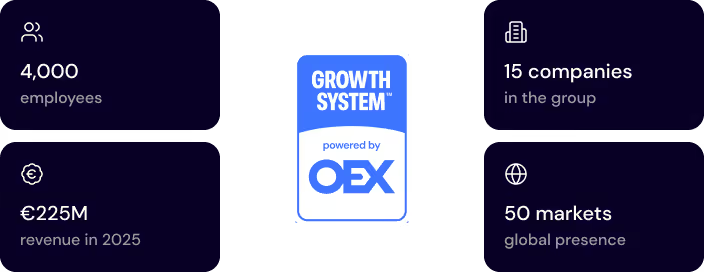
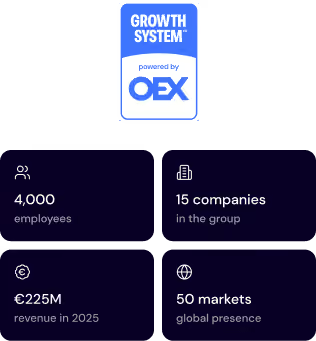
Part of an international capital group
Recognized by Google, Deloitte, and Gartner

35 loyalty and gamification experts


Helping customers in over 60 countries
Sleep well with rock-solid security and scalability

ISO and GDPR compliance

OWASP and CWE certifications

Global availability with AWS
See what customers say about working with us