Loyalty system architecture determines what a program can do, how fast it can change, and whether it holds up as the business grows. Modern platforms are built from independent, modular components – a rules engine, a points ledger, an API layer – that can scale, integrate, and evolve without bringing the whole system down. This approach, rooted in broader software industry principles, solves real problems: traffic spikes, integration complexity, and the pace at which loyalty teams need to move.
Running a loyalty program means operating on two timescales at once. The program needs to reflect a long-term brand strategy – consistent, considered, and built around a genuine understanding of customer behavior. At the same time, it needs to move fast: responding to shifting customer expectations, capitalizing on real-time marketing opportunities, and adjusting mechanics before a window closes. Most platforms are designed for one or the other. Very few handle both well.
That's rarely a strategy problem. More often, it comes down to how the platform is built – and whether its architecture can support the pace the business actually needs. Two programs can offer identical rewards and look identical to the customer, while one takes six months to update a promotion and the other ships the same change in a day. The difference isn't visible in a demo, it shows up months into the contract.
And yet, platform architecture is rarely part of the conversation early enough. Loyalty managers evaluate features, pricing, and integration lists. Product owners assess implementation timelines. C-level stakeholders sign off on the business case. By the time the architectural constraints become visible – when a new campaign stalls in a development queue, or a partner integration takes twice as long as expected – the decision has already been made.
This article is about making that decision with better information. It breaks down how modern loyalty platforms are built, what the core components actually do, and what separates architectures that scale from those that quietly become a ceiling.
Modern loyalty platforms are not single pieces of software. They are ecosystems of specialized components, each responsible for a distinct function – and this modular approach is part of a broader shift in how enterprise software is built today.
Understanding what each component does – and how they depend on each other – is the foundation for evaluating any loyalty platform, whether building one from scratch or assessing an existing stack.
The rules engine is the decision-making core of any loyalty platform, evaluating incoming customer events – a purchase, a referral, a product review – against a set of configurable conditions, and determining what should happen next: points awarded, a tier unlocked, a reward triggered.
A rigid engine might support simple earn rates – one point per dollar spent. A modern rules engine can evaluate multiple conditions simultaneously: the customer's tier, the product category, the time of day, the channel, and whether a specific campaign is active. That combination of contextual logic is what makes personalized, real-time promotions possible without custom development for every campaign.
For loyalty managers, the practical question is who controls the rules. In well-architected platforms like Open Loyalty, rule configuration is accessible to non-technical teams – meaning a new promotion doesn't require a developer ticket. In less flexible systems, every logic change goes through an engineering queue, which is where the eighteen-month contract problem begins.
The points ledger is the financial record of the loyalty program. Every point earned, redeemed, transferred, or expired is logged here, with a full audit trail. It sounds straightforward – and conceptually it is – but the ledger is one of the most technically demanding components to build at scale.
When a customer completes a purchase, points must be added exactly once, even if the network request is retried or a system hiccup causes the transaction to be processed twice. A ledger that doesn't handle this correctly produces balance errors that are difficult to detect and expensive to fix – both technically and in terms of customer trust.
At high transaction volumes, the ledger also needs to handle concurrent reads and writes without degrading performance. This is why modern platforms treat the points ledger as an independent service rather than a field in a broader customer database.
Once a reward has been triggered by the rules engine, something has to actually deliver it. The fulfillment service handles the generation and distribution of rewards: producing unique voucher codes, initiating cashback transfers, granting access to exclusive content, or triggering a notification to a downstream system.
The complexity here is less about the mechanics and more about reliability. A customer who completes a qualifying action expects their reward to appear promptly. If the fulfillment service is tightly coupled to other parts of the system, a failure anywhere in the chain can delay or prevent delivery.
Modern architectures decouple fulfillment so that reward distribution can continue even if, say, the analytics pipeline is temporarily down.
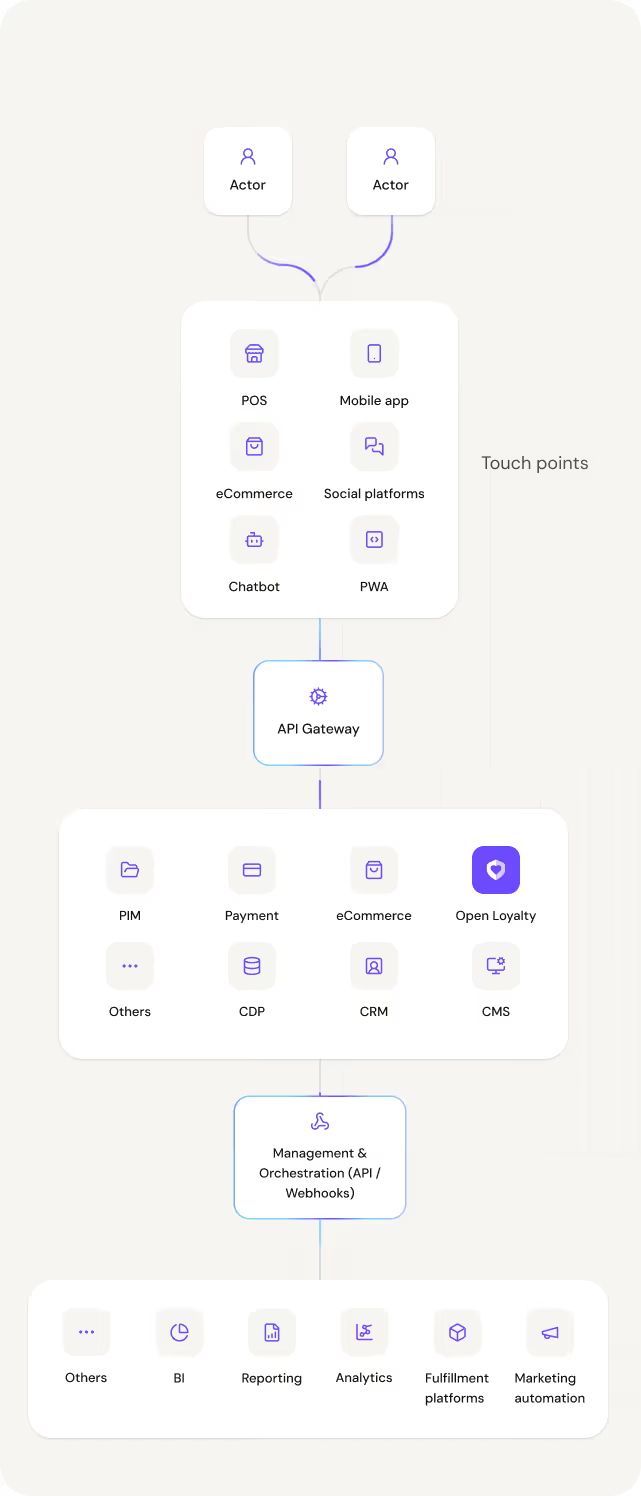
The API layer is the interface between the loyalty platform and everything outside it – the mobile app, the e-commerce checkout, the point-of-sale system, the CRM, the marketing automation tool. Every customer interaction that touches the loyalty program passes through the API.
In well-designed platforms, the API is built on REST principles: it's stateless, versioned, and documented clearly enough that integration teams can work against it without needing access to the underlying codebase. Idempotency – the guarantee that sending the same request twice produces the same result only once – is a critical property for loyalty APIs, where duplicate point awards or double redemptions are a real operational risk.
The API layer is also where access control lives. Different systems need different levels of access: a customer-facing app should be able to read a points balance but not modify it directly; a POS integration needs write access for transactions but not for member administration. A properly designed API layer enforces these boundaries without requiring custom logic in each integration.
Traditional digital systems are built on a request–response model: one system asks for something, another system replies. In loyalty, that usually means the loyalty engine calling out to a CRM, a marketing platform, or an app backend every time something changes.
Event‑driven architectures flip that dynamic. Instead of waiting to be asked, the loyalty platform – along with commerce and other core systems – continuously emits business events: “order completed,” “tier upgraded,” “reward issued.” Downstream systems subscribe to the events they care about and decide for themselves how to respond in real time.
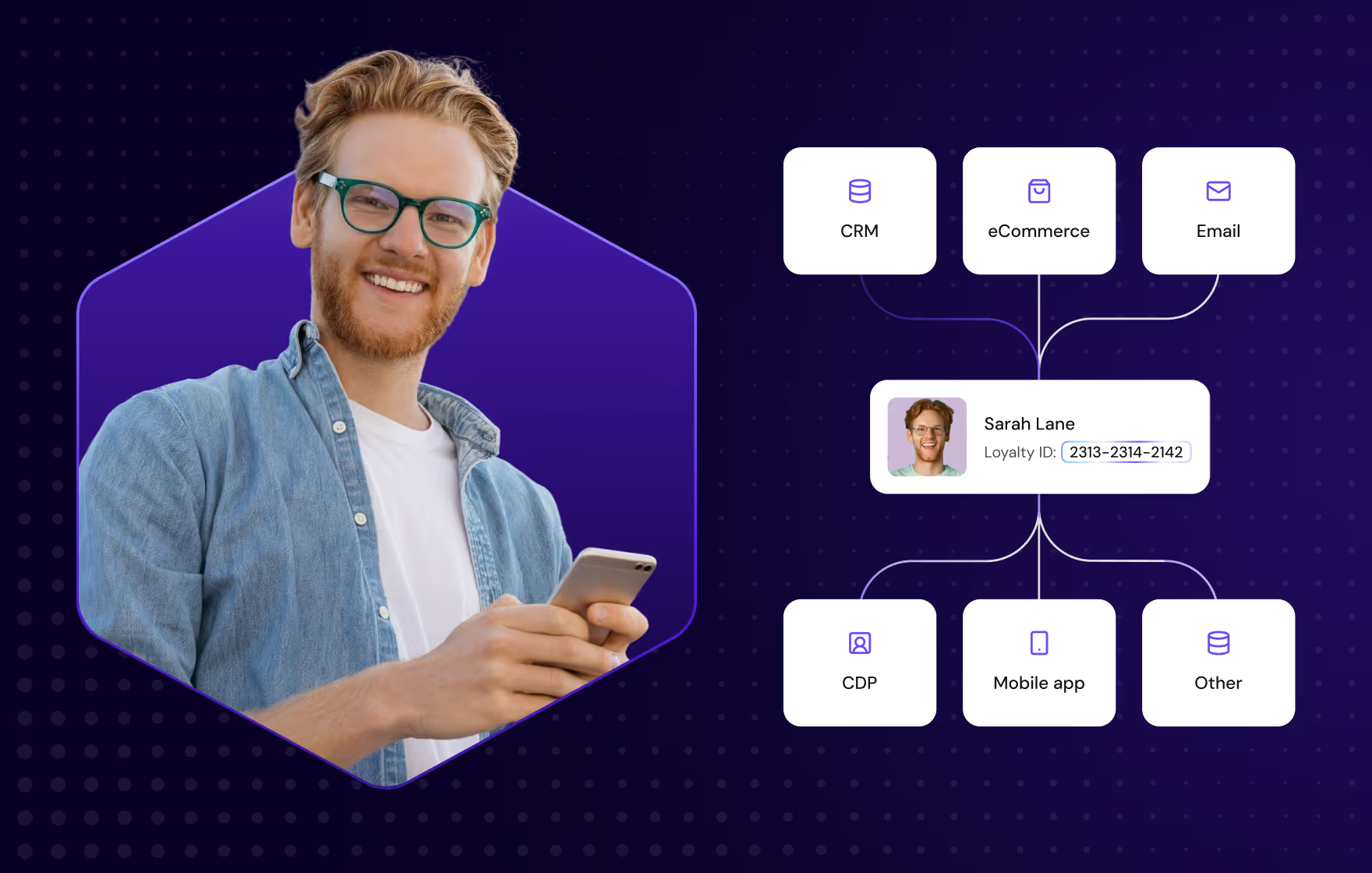
That shift matters because loyalty never lives in isolation. A single tier upgrade might need to trigger an email, refresh someone’s profile in the CRM, and unlock a new offer in the mobile app simultaneously. In a request–response world, the loyalty platform has to know about and talk to each of those systems directly. In an event‑driven world, it simply publishes the event and lets each domain do its job. This decoupling makes the entire ecosystem far easier to extend and evolve without constantly rewiring the core loyalty logic.
The customer data layer is where member profiles live: identity, behavioral history, segment membership, communication preferences, and any other attributes the rules engine needs to personalize rewards. In modern architectures, this is often a Customer Data Platform (CDP) that aggregates data from multiple sources into a unified member record.
The quality of this layer determines the quality of personalization. A rules engine can only be as contextually aware as the data it has access to. If the customer data layer holds only transaction history, the program can personalize based on spend. If it holds behavioral signals – browsing patterns, product affinities, channel preferences – the program can do considerably more.
Data layer design also has compliance implications. Member data needs to be structured in a way that supports consent management, right-to-erasure requests, and audit requirements – considerations that are easier to build in from the start than retrofit later.
The components above don't operate independently – they form a chain that activates every time a customer takes an action.
A simplified flow looks like this:
The key characteristic of this flow in a well-architected system is that each step is handled by an independent service. If the fulfillment service experiences a delay, the ledger update still completes; if the CRM integration is temporarily unavailable, the reward is still issued.
Failures are contained rather than cascading – which is the difference between a minor operational hiccup and a program-wide outage during a high-traffic promotion.
The short answer is: it depends on what the program needs to do. A basic stamp card doesn't require a distributed microservices architecture. But a loyalty program operating across multiple channels, responding to customer behavior in real time, integrating with a CRM, a POS, a mobile app, and a partner network – that program has genuine complexity, and the platform needs to be built to match it.
The longer answer is that the complexity isn't unique to loyalty. It reflects a broader challenge that the entire software industry has been working through for the last two decades: how to build systems that can scale, change, and integrate without becoming progressively harder to maintain.
For much of enterprise software history, commercial systems were built as monoliths: tightly coupled applications, often backed by a shared database and deployed as a single unit. Everything lived together, everything depended on everything else – and releasing a change usually meant releasing the whole system, loyalty platforms included.
This architecture worked well enough when programs were relatively simple and integration requirements were limited. As expectations grew, however, the trade-offs became harder to ignore. Scaling for a peak promotion often meant scaling the entire stack. A bug in one module could affect otherwise unrelated functions. Changing a reward mechanic frequently required touching code that many other parts of the system depended on.
In practice, the monolithic model traded long-term flexibility for short-term simplicity – and beyond a certain scale, that trade became increasingly difficult to justify. The industry needed a different approach, and loyalty, as a discipline built on real-time interaction and constant iteration, had much to gain from it.
The response to these limitations emerged as part of a broader architectural shift across enterprise software, formalized in the principles championed by organizations such as the MACH Alliance. Rather than relying on a single shared codebase, MACH promotes systems composed of independent, loosely coupled components – built around microservices, exposed through APIs, deployed cloud-natively, and decoupled at the presentation layer.
We believe in “Transform by Doing”. The MACH architecture enables us to build and run solutions that are less of a compromise to our clients. MACH solutions can reduce time to first value significantly and are much more adaptable to the ever evolving business needs and customer expectations, says Auke van Urk, Advisory Board Member to the MACH Alliance and Chief Technology Officer at Valtech.
In loyalty, this architectural logic applies at multiple levels of the stack.
At the ecosystem level, the loyalty platform itself becomes a standalone component that can be connected to – or replaced within – the broader infrastructure. Within the platform, functional modules such as the rules engine, points ledger, or fulfillment service can operate more independently, reducing the likelihood that a failure or update in one area will cascade across the rest of the system. The same design logic can repeat from the ecosystem level down to individual services.
The result is a platform that can move at the pace the business requires: launching new promotions in days rather than months, adding channels without large custom development projects, and scaling only the services needed during high-traffic events instead of provisioning infrastructure across the entire stack.
The architectural principles behind MACH and composability aren’t abstract ideals – they exist because loyalty programs consistently run into operational problems that monolithic systems handle poorly.
Three challenges appear again and again in real-world implementations:
Modern loyalty architecture is designed to address each of these directly.
Loyalty platforms don’t experience steady, predictable load. A routine midweek transaction flow looks nothing like the opening hours of a double-points promotion. In monolithic architectures, handling these spikes typically requires scaling the entire stack – even the components that aren’t under pressure – which is both slow and costly.
Composable architectures take a more targeted approach. Because services operate independently, only the components actually under load – such as the rules engine during a flash promotion – need to scale.
Real-time responsiveness depends just as much on how the platform processes events. Modern loyalty systems rely on event-driven architectures that handle transactions asynchronously, allowing actions like points updates to be reflected almost immediately, even at high volume.
The greater challenge lies in maintaining data consistency across multiple services updating the system simultaneously. Many platforms address this through eventual consistency – allowing brief delays in updates – and coordination patterns to manage multi-step workflows. If a redemption process fails midway, the system can roll back prior steps cleanly, preventing account errors during peak traffic.
Scalability matters. But in practice, what most often determines whether a loyalty program delivers on its promise is the quality of its integrations – how cleanly the platform connects to the systems where customer interactions actually happen.
Loyalty platforms need real-time data from the POS to award points at checkout, live connections to e-commerce systems to surface relevant rewards during the purchase journey, and access to CRM or CDP data to make personalization meaningful rather than generic. They also need to push updates to mobile apps quickly enough that the experience feels responsive rather than delayed.
Each of these connections introduces its own complexity – and most integration failures aren’t purely technical but stem from scoping gaps. Teams discover mid-implementation that the POS doesn’t emit the right events, or that the CRM’s data model doesn’t map cleanly to the loyalty platform’s member schema. Others find that integrations which perform well in testing degrade under production load, where real-time loyalty experiences impose latency requirements functional tests rarely surface.
Platforms built API-first – where every function is accessible programmatically and the API contract is stable and well-documented – reduce this integration friction significantly. In practice, the most effective loyalty programs are rarely those with the most sophisticated reward mechanics. They’re the ones connected well enough to act on customer behavior as it happens.
In traditional loyalty platforms, the frontend – what the customer sees – is tightly coupled to the backend logic that powers it. Adding a new touchpoint, such as an in-store kiosk or self-checkout, often means extending a system that wasn’t designed for it.
A headless loyalty engine decouples the two: the backend runs independently, exposes its capabilities through APIs, and can serve any channel that can make an API call.
For omnichannel retailers, this becomes a customer experience issue. A shopper might earn points in-store, check their balance in an app, and redeem a reward later at self-checkout. In a headless architecture, the same backend powers every surface, ensuring the member’s balance stays accurate everywhere. Separate, channel-specific implementations trying to stay in sync are a common cause of failures – like points that don’t appear after purchase or rewards that can’t be redeemed across channels.
Decoupling also improves delivery speed. Updating the frontend no longer risks breaking backend logic, allowing teams to launch seasonal interfaces, test checkout experiences, or introduce new touchpoints without modifying the core loyalty engine.
After several sections making the case for composable, API-first architecture, it is worth being direct: this is not an argument that every business should rebuild its loyalty stack. The principles behind MACH are genuinely powerful, and the problems they solve are real – but they are specific problems, and not every loyalty program has them yet.
A simpler, all-in-one platform is often the right choice for a business running an early-stage or single-channel program, for teams without the technical resources to manage a distributed architecture, or for organizations where getting a program live quickly matters more than building for long-term flexibility. Monolithic platforms exist because they solve a real set of problems well. The limitation is that they tend to solve them at a fixed ceiling – and the ceiling becomes visible only after the contract is signed.
The honest framing is that modern loyalty architecture is an investment in future agility, not an immediate unlock. It costs more to implement correctly upfront, requires more from the teams managing it, and takes time to deliver its return. That return – launching campaigns in days rather than months, adding channels without custom development, scaling specific services under load without provisioning the entire stack – is real, but it accrues gradually. For businesses at the scale and complexity where those capabilities are already a constraint, the investment makes clear sense. For those that aren't there yet, the more pragmatic move is often a simpler platform with a clear migration path when the program outgrows it.
The architecture should follow the program's actual needs – not the other way around.
It refers to how the technical components of a loyalty platform – the rules engine, points ledger, API layer, and data systems – are structured and connected.
Architecture determines what the program can do, how fast it can change, and whether it holds up as the business scales.
A monolithic platform bundles all functionality into a single system – easier to implement initially, but harder to change and scale over time.
A composable platform is built from independent services that communicate through APIs, allowing individual components to be updated, scaled, or replaced without affecting the rest of the system.
It means every function of the loyalty platform is accessible programmatically through an API, from day one. This approach makes integration with other systems – POS, CRM, mobile apps – faster and more reliable, and ensures the platform can serve any channel without custom development for each new touchpoint.
A headless loyalty engine separates the backend logic from the customer-facing frontend. The backend handles all loyalty operations and exposes them through APIs; any channel – app, website, kiosk, POS – can connect to it independently.
Not always. Composable architecture solves problems of scale, integration complexity, and iteration speed. If a program is early-stage, single-channel, or has limited integration requirements, a simpler all-in-one platform is often the more pragmatic choice. The right architecture is the one that matches the program's actual needs today – with a clear path to evolve when those needs change.
Most integration failures are scoping problems, not technical ones. Teams discover mid-implementation that the POS doesn't emit the right events, or that the CRM data model doesn't map cleanly to the loyalty platform's member schema. Integrations that work in testing can also degrade under production load. The best protection is rigorous upfront scoping and choosing a platform with a stable, well-documented API.
The most important ones: Can non-technical teams change reward logic without developer involvement? Is the API versioned and stable? What events does the platform emit? How does it handle failures in downstream systems? And who owns the data – can it be exported in full? These questions are harder to answer in a sales process than feature questions – which is exactly why they're worth asking.

API-first loyalty and gamification engine

Get a weekly dose of actionable tips on how to build and grow gamified successful loyalty programs!