Loyalty programs are infrastructure when they work, and a profit leak when they don't – and the difference almost always comes down to model fit rather than execution quality.
This article breaks down five loyalty architectures (points, tiered, cashback, paid, gamified), explains the behavioral mechanics and economic logic behind each, and identifies the specific business conditions each model requires to generate return. The through line: the right program solves a real problem for a specific customer base at a sustainable cost; the wrong one looks busy while solving nothing.

Loyalty programs are one of the most reliable growth levers in consumer business: Costco’s membership renews at 92.9% annually and brings in $4.8 billion in near–pure-profit revenue, while Delta Air Lines’ SkyMiles program accounted for 57% of total company revenue in 2024. At their best, loyalty programs aren’t a marketing expense but a profit engine. The problem is that most of them never get there.
Designing for that fit is not just a strategic decision – it’s an operational one. The mechanics behind points, tiers, cashback, or gamification must be implemented through loyalty software that supports the right incentives at the right cost. Platforms like Open Loyalty are built around this idea: that the effectiveness of a loyalty program depends less on execution quality than on whether the model aligns with actual customer behavior.
This article is about fit – and what each loyalty model actually needs to work: the right purchase frequency, the right margin structure, the right customer psychology, and the right category dynamics. Let’s look at when these conditions line up to create value – and when they quietly turn loyalty into a cost center.
Not all loyalty programs are built the same – and the differences matter more than most businesses realise before they've already committed to a model.
Here is what each architecture actually requires to generate return, and where each one tends to quietly fall apart.
Points systems are the most common loyalty model for a reason: they’re easy to run and easy to understand. Customers earn points per transaction – or for certain actions – and redeem them later for rewards.
Using an abstract currency like “points” instead of money serves a purpose. It makes the real value of the reward harder to calculate, which keeps customers focused on accumulation rather than trade-offs. That ambiguity is both where the model creates economic value and where customer frustration often begins.
One of the core economics behind points programs is breakage – points that are earned but never redeemed. Companies can recognise this unused value as revenue, and in most retail programs, a meaningful share of points goes unused. This isn’t a flaw in the system; it’s part of how the system works.
Behaviorally, points programs rely on a simple dynamic: people speed up as they get closer to a reward. When customers can see their progress toward the next benefit – whether through a progress bar, a stamp count, or a visible points balance – they’re more likely to make another purchase to close the gap. These interface elements aren’t just helpful UX; they’re designed to increase purchase frequency by making the next reward feel within reach.
By turning rewards into something earned over time, points programs keep customers psychologically invested between purchases – giving them a reason to come back.
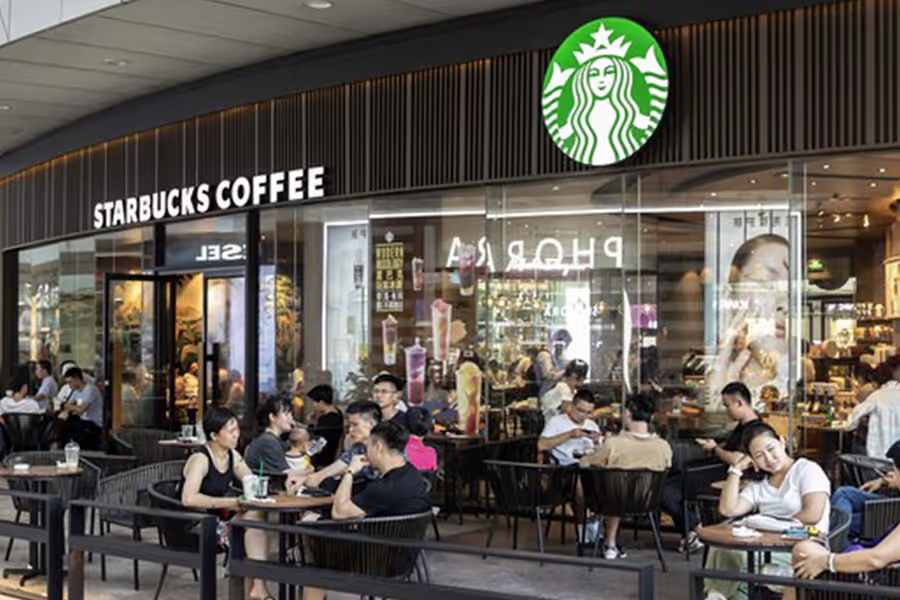
Starbucks layers personalized challenges, double-star days, and in-app promotions on top of its points system – but ties each to a purchase. Stars are earned by buying something, not by tapping through a game. That’s the difference between mechanics that drive revenue and mechanics that drive engagement without spending.
Our first quarter performance was strong on many measures. Of note was the unwavering commitment of our most loyal customers, the growth in rewards members, tender and spend per member – said Laxman Narasimhan, CEO, Starbucks Reports Q1 Fiscal 2024 Results.
Points programs are hard to change once they’re set. When customers accumulate points, any shift in how quickly they earn or redeem them tends to feel like a broken promise. Airlines and hotel groups regularly devalue their programs, and the backlash is predictable: media coverage, social media complaints, and a drop in trust among the most engaged members.
Tiered programs add a status layer to rewards. Customers move up through levels by hitting spend or points thresholds, unlocking better benefits at each step along the way. The psychology here is different from a standard points program: the goal isn’t just to earn something, but to become something.
What drives these programs is loss aversion – people care more about avoiding losses than achieving equivalent gains. A customer who’s two purchases away from losing their Gold status will usually do more to protect it than someone who’s two purchases away from gaining it.
In practice, the threat of a downgrade motivates more action than the promise of an upgrade. That’s why airlines highlight tier expiry dates so prominently. These reminders aren’t just informational – they’re meant to prompt behavior.

Sephora’s Beauty Insider program is a textbook example of a tiered loyalty structure built around spend. Instead of offering the same rewards to everyone, Sephora segments members into three levels – Insider, VIB, and Rouge – based on how much they spend each year. The more you spend, the more benefits you unlock: early access to product launches, higher-value rewards, exclusive events, free shipping, and better redemption options.
This does two things at once.
First, it creates visible status differences between customers. Your tier becomes a signal – not just of how much you’ve spent, but of what kind of customer you are. Second, it introduces a rolling annual threshold. If you’re close to qualifying for the next tier (or keeping the one you have), there’s a clear incentive to make one more purchase before the year resets.
This approach turns the loyalty program into a spend-acceleration mechanism. Customers aren’t just buying because they want the product – they’re buying to reach Rouge before December, or to avoid dropping down a tier next year.
It's not just about earning points … It’s important that our loyalty program also allows customers to have special access to extra benefits, said Emmy Berlind, Senior Vice President and General Manager of Loyalty at Sephora
Tiered programs with shallow differentiation between levels do more harm than good. If Silver and Gold members receive essentially the same experience – say, a slightly different earn rate on a currency they do not fully understand – the tier structure signals VIP intent while failing to deliver VIP reality. Members in lower tiers feel implicitly downgraded rather than rewarded.
The other failure mode is status inflation: too many members reaching top tiers dilutes the exclusivity that made the tier valuable.
Cashback programs return a transparent percentage of spending directly to the customer – 2% back means 2% back. Every dollar earned is a direct margin cost the business has to fund, whether through interchange fees (in financial services), the value of the data the program generates, or the behavioral uplift it creates in spending frequency or basket size.
This transparency is both the model’s biggest advantage and its main limitation. Because the value is explicit and cash-equivalent, cashback tends to function more like a financial incentive than a relationship-building tool. Customers may appreciate the benefit, but that doesn’t necessarily translate into emotional loyalty to the brand offering it.
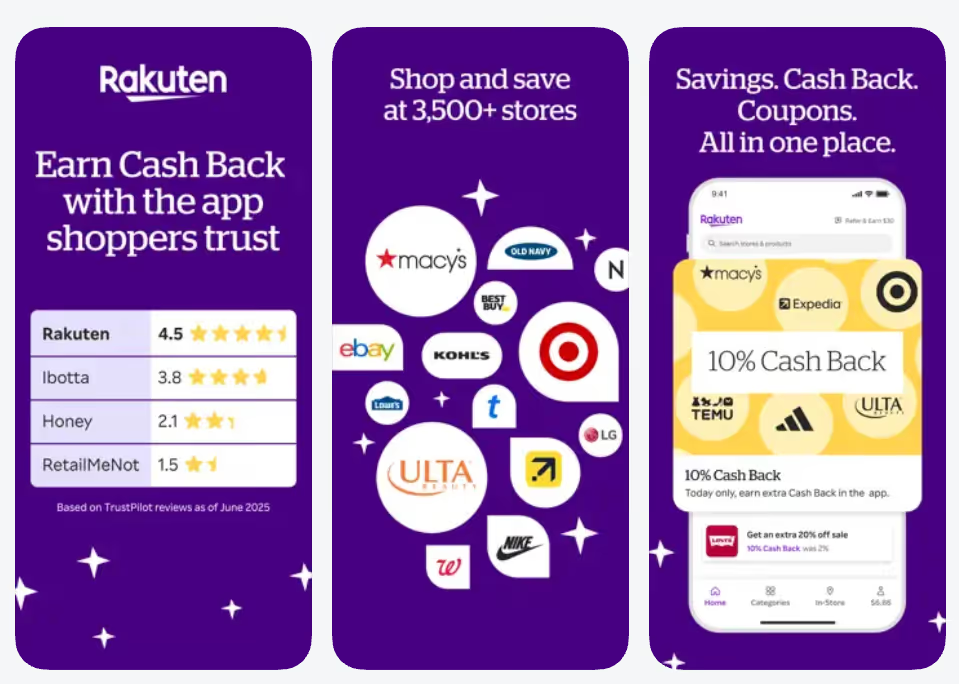
Rakuten shares a portion of the affiliate commission it receives from retailers directly with customers as cashback, but ties every reward to a completed purchase. Cashback is earned by buying something through a tracked referral link, not by interacting with an app or engaging with brand content.
Our 17M+ members in the U.S. have earned over $4.6B in Cash Back at their favorite stores. – Rakuten Company Overview
Cashback programs are expensive to fund once they’re established. Every percentage point returned to the customer must come from somewhere – whether that’s interchange fees, affiliate commissions, or retail margin. When that funding is pulled from product margin, the program creates pressure to raise base prices or reduce promotional activity elsewhere.
The other structural limitation is affinity. Cashback programs tend to generate economically rational usage rather than emotional loyalty. Customers engage for the return, not for the brand – which makes the model effective at driving transactions, but weak at building preference beyond price.
Paid loyalty programs charge customers an upfront fee in exchange for access to program benefits. That fee serves two functions at once: it selects for customers who already intend to engage deeply with the brand (selection effect), and it creates a psychological incentive to use the program enough to justify the cost (sunk cost effect).
Of the two, the selection effect is more important. Customers who pay a membership fee have already signaled a willingness to invest in the relationship. As a result, the behavioral data that follows reflects, in part, who chooses to join – not just what the program does to them. This distinction matters when interpreting headline spending comparisons between paid and non-paid members.
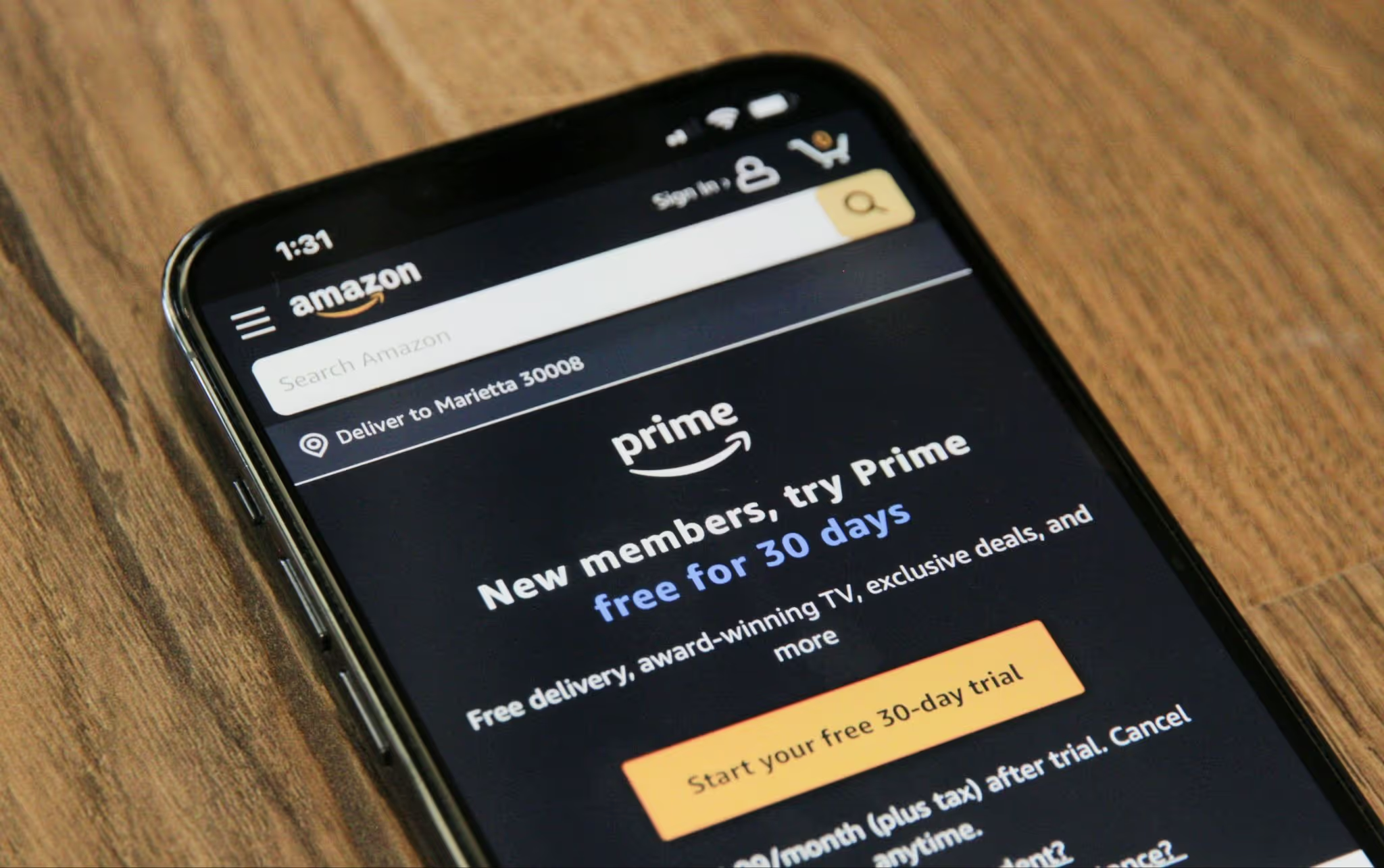
Amazon's program design insight was not loyalty mechanics – it was friction removal. The original Prime value proposition was free two-day shipping. Amazon identified that shipping costs were causing cart abandonment and designed a paid membership specifically to eliminate that friction. The program did not start by trying to create loyalty – it started by solving a real customer problem.
Amazon Prime started with unlimited, free, two-day delivery for a million products; it's now grown to over 300 million items, with tens of millions available in one day (or better). An increasing number of deliveries happen the same day, according to Amazon Annual Report.
Paid programs fail when the fee cannot be justified by the value delivered. The expectation threshold for paying members is higher and less forgiving: if a customer has paid for the disappointing experience, the dissatisfaction is amplified by the prior financial commitment. Free programs produce indifference when they underdeliver. Paid programs produce active resentment.
The other failure mode is charging for what should be standard service – packaging existing offerings as exclusive perks without genuinely changing what the customer receives.
Gamified loyalty programs use game mechanics – progress bars, badges, challenges, streaks, leaderboards – to make participation feel like interactive engagement rather than a transactional exchange.
Their psychological foundation is variable-reward scheduling: unpredictable reward intervals tend to drive stronger, more persistent engagement than predictable ones. The same mechanism underpins behaviors ranging from mobile game play to slot machine use.
What determines whether a gamified program drives revenue or simply boosts engagement metrics is where those mechanics are applied: Are rewards tied to purchase actions, or to non-transactional engagement?
Programs that award badges for visiting a store page, sharing on social media, or completing surveys may increase interaction and generate engagement data – but not necessarily sales. In these cases, gamification functions primarily as an attention-retention layer rather than a revenue driver.
The operational question is not whether engagement improves – it almost always does – but how success is measured. When gamified programs are evaluated against app opens, time-in-app, or session duration, they tend to perform well regardless of their commercial impact. These metrics are easier to move – and easier to mistake for loyalty. Programs assessed against purchase frequency, basket size, or customer lifetime value, by contrast, reveal whether game mechanics are reinforcing buying behavior or simply extending platform interaction.
Nike integrates challenges, streaks, badges, and milestone rewards across its Nike Run Club and Nike Training Club apps – turning training activity into a progression system tied to brand engagement. Users unlock achievements through completed workouts, run streaks, and challenge participation, which in turn surfaces personalized product recommendations and early access to relevant gear.
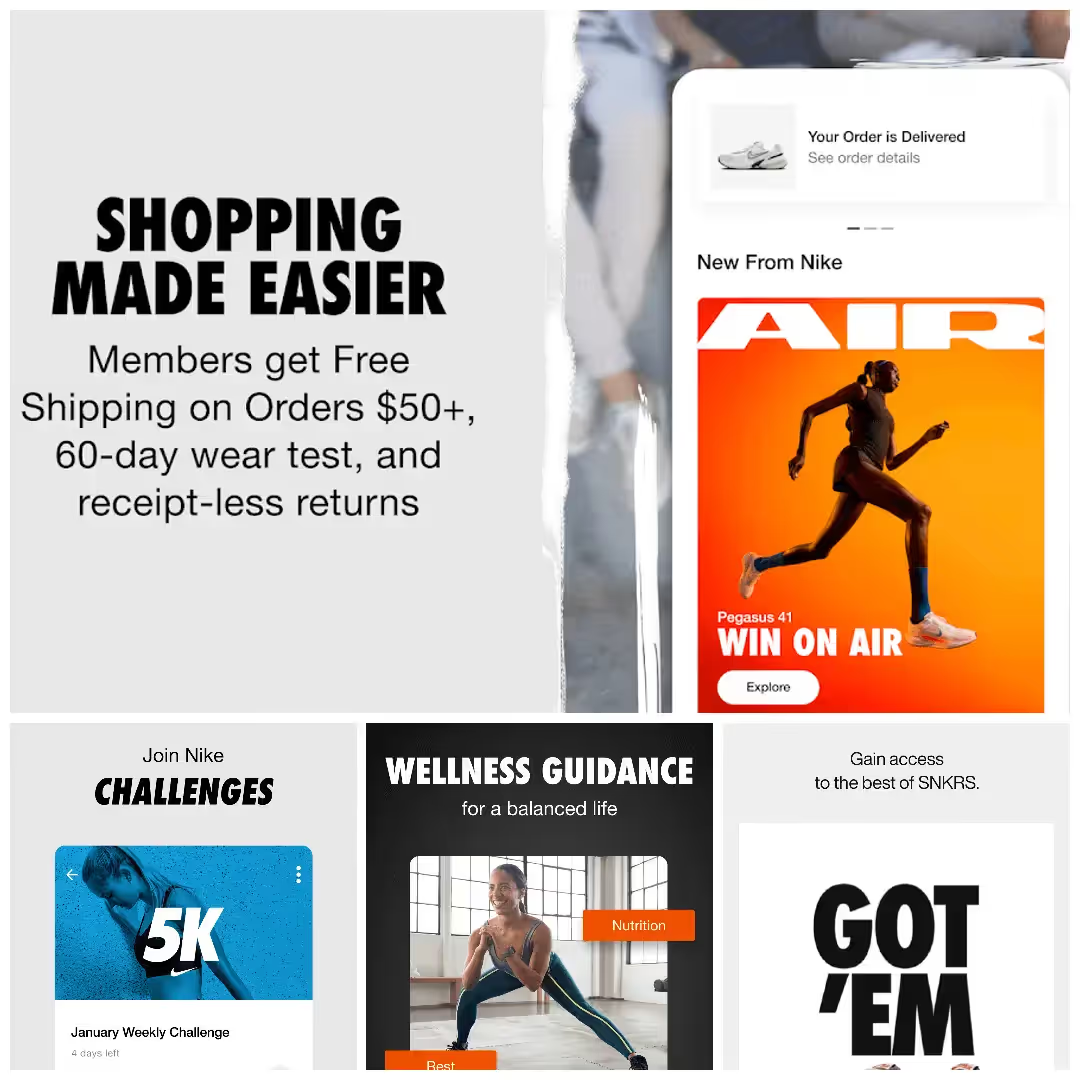
Nike’s gamification layer is not designed as a standalone engagement loop. It connects activity tracking to commerce by linking completed challenges and usage patterns to targeted offers, product drops, and member-exclusive access – tying participation back to spend rather than app usage alone.
Our digital ecosystem, including Nike Run Club and Nike Training Club, continues to drive deeper member engagement and fuel demand across our product portfolio, according to Nike FY2023 Annual Report.
Gamification requires purchase frequency to work as habit reinforcement. A gamified program for a car dealership – where the average customer purchases once every several years – cannot build meaningful momentum between transactions. The streaks break, the challenges expire, and the program produces brief active periods followed by long dormancy. Without repeat purchase cycles to anchor progression, the mechanics lose their behavioral reinforcement function and revert to episodic engagement – generating participation spikes without sustained commercial impact.
Most frameworks for choosing a loyalty program start with the models and ask which one fits your business. A more useful approach is to reverse that logic: start with your customers’ actual behavior, then work backward to the mechanics most likely to change it.
Purchase frequency is the most constraining variable in loyalty program design. Points accumulation, tier progression, goal-gradient effects, and gamified streaks all rely on enough transaction volume to create momentum before customers disengage or forget they’re enrolled.
If the model depends on behavior your purchase cycle can’t support, it won’t drive meaningful change.
Before choosing a model, identify the real barrier to repeat purchase.
A loyalty program that doesn’t address the primary friction may generate activity, but not incremental revenue.
This is often treated as a final check, but it should be an upfront filter.
The model with the strongest behavioral impact may still be economically unsustainable at your margin structure. If the incentives required to shift behavior exceed the value of that shift, the program becomes a long-term cost rather than a growth lever.
A loyalty program buys you information: who your customers are, how often they visit, what they buy, and whether changes to your offering affect their behavior. That data is genuinely valuable – and it's why even programs with modest behavioral impact can be worth running, as long as they're operated honestly and at a sustainable cost.
What a loyalty program does not buy is loyalty in any lasting sense. A customer who shops with you because your points program is better than your competitor's will leave when your competitor improves theirs. A customer who has paid for a membership has made a financial commitment that raises the switching cost – but only because the program solved a real problem for them. Take that away, and the commitment goes with it.
In that way, a loyalty program is a mirror. It reflects what customers already think about your brand. Layered onto a poor product experience, it simply gives you a better-instrumented version of the same problem – more data about why people are leaving, not a reason for them to stay.
The companies that get the most from loyalty programs didn't build them to manufacture loyalty. They built them to make an existing value proposition easier to access – and easier to stick with.
Choose the model that fits your actual customer behavior and your real margin structure. Design it around a problem you're solving, not a reward you're inventing.
Transactional loyalty means customers come back because the reward makes it worth it – points, discounts, cashback. Emotional loyalty means they come back because they like the brand. Transactional loyalty is easier to build and easier to lose. Emotional loyalty takes longer, but it’s harder for competitors to win away. The best programs use both.
Use a holdout group: eligible customers who aren’t enrolled. If members aren’t outperforming non-members on frequency, basket size, or retention, the program isn’t creating lift – it’s just giving discounts.
When members can’t quickly answer: how many points do I have, and what can I do with them? If redemption is low, complexity is usually the reason.
Three things: data ownership (can you export raw behavior?), flexible reward logic (can you combine different mechanics?), and clean integrations with POS, e-commerce, and CRM.
Not necessarily – but the economics have to work. The cost of running the program should be justified by the behavior it changes. Start with the business problem, not the platform.

API-first loyalty and gamification engine

Get a weekly dose of actionable tips on how to build and grow gamified successful loyalty programs!