For Loyalty Program Managers already running CAC, AOV, and redemption-rate math, the real decision isn't 'what is a VMS' but which architecture, legacy SaaS, custom build, or API-first engine, matches your integration complexity and growth trajectory.
This guide breaks down the mechanics, the vendor evaluation checklist, and the cost trade-offs before you commit.
A voucher management system (VMS) runs voucher lifecycle management, issuance, distribution, redemption tracking, and voucher expiration rules, as one connected process rather than three disconnected spreadsheets bolted onto a payment gateway.
Most programs don't fail at issuance. They fail at reconciliation, when a voucher redeemed in-store doesn't match what the CRM shows online, and nobody can tell if that's fraud or a sync delay. In our work deploying voucher engines across retail, banking, and airline rollouts, we've seen fraud prevention and reporting complexity scale fast once a program expands into a multi-country rollout.
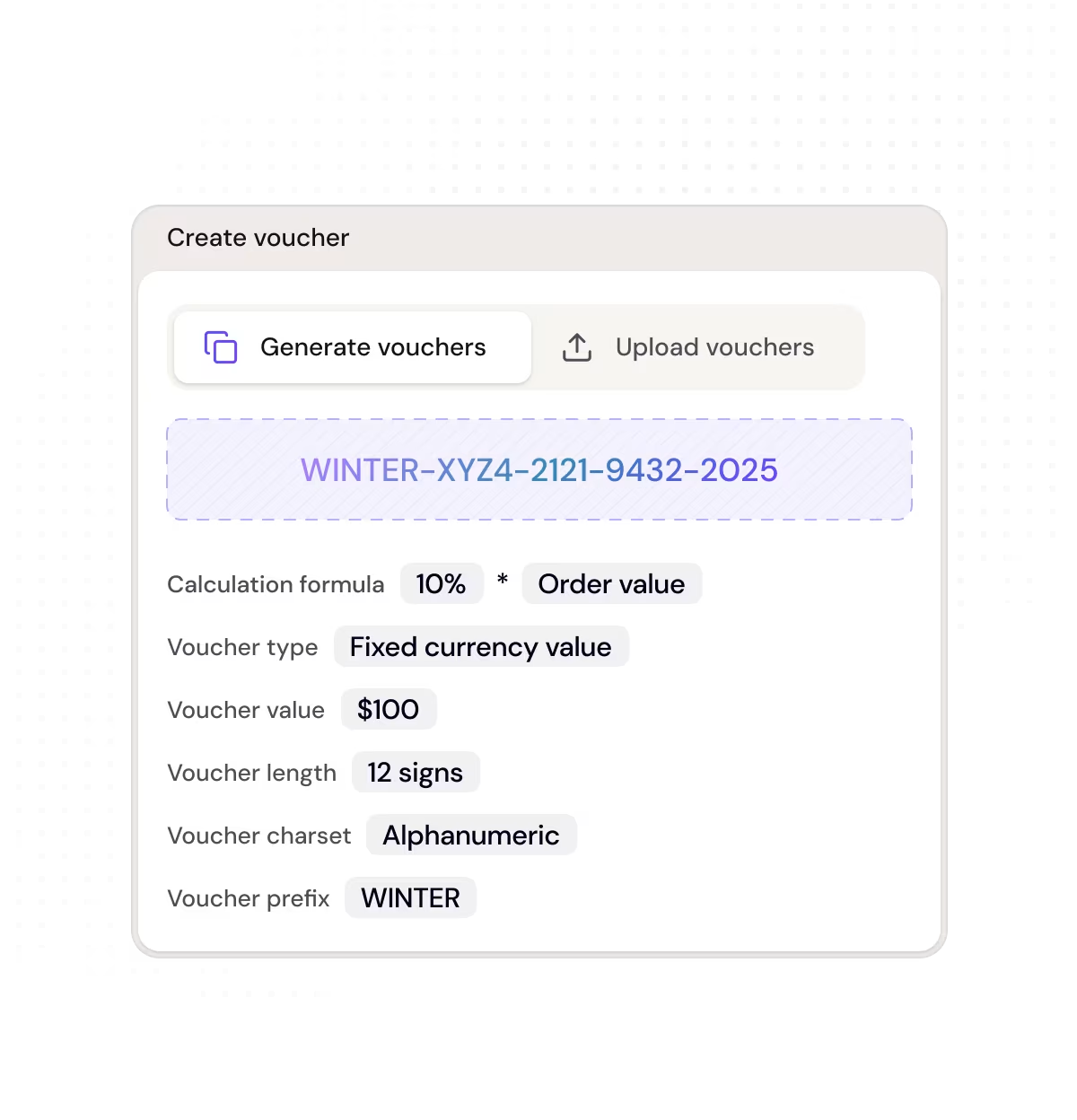
A modern VMS puts issuance, redemption reporting, and fraud prevention controls on separate tabs of one dashboard, with each voucher's contents, value, PIN, expiration date, synced through API-first architecture so managers see live data and take action without waiting on IT.
Industry benchmarks put average redemption rates across enterprise loyalty programs near 20 percent, a gap that voucher lifecycle management, not issuance volume alone, is built to close across every market a program runs. The overview below breaks down lifecycle stages, where API-first architecture cuts vendor lock-in risk, and what a realistic total cost of ownership model looks like against legacy SaaS.
A voucher management system (VMS) moves each voucher through four linked stages: issuance, distribution, redemption tracking, and expiration enforcement. Every voucher management system generates unique voucher codes at the point of issuance, ties each one to a customer record, and pushes it out through whatever channel a program specifies, email, SMS, POS terminal, or a mobile wallet PIN.
Redemption tracking is where most manual setups break. Without a live webhook-based integration between POS and CRM, a code redeemed in-store shows as "open" online for hours, and reporting tabs across systems disagree on the same order.
An API-first architecture fixes this by pushing redemption events as they happen, so reporting stays consistent across every channel and country in a multi-country rollout. That data consistency is what separates a VMS from a legacy SaaS bolt-on: Industry gift card breakage rates typically range 5-15% of total gift card sales value (Ncentiva Blog, 2024).
A multi-country rollout shows how much reconciliation time disappears once redemption events and voucher expiration rules run through a single system rather than three regional exports.

Before committing, ask any vendor for SOC 2 Type II attestation and a total cost of ownership model that includes exit costs. Vendor lock-in shows up in the migration bill, not the sales deck.
A voucher management system's core feature set breaks into three functional groups: issuance, fraud prevention controls, and reporting. Issuance centers on batch voucher generation, creating thousands of unique codes through a single API call rather than issuing them one at a time, which can take days when a retail promotion or airline campaign needs to seed a new market overnight.
Fraud prevention controls sit at the center of the system, not bolted on afterward. Loyalty program fraud costs retailers ~$1 billion annually in direct and indirect losses (Agilence, 2024).
Attackers exploit predictable patterns, and a mature system closes each one:
Duplicate redemption: the same code used across multiple channels or devices before the ledger reconciles. Real-time redemption locking flags the second attempt instantly.
Velocity abuse: bots or fraud rings hammering a PIN entry field to brute-force valid codes. Per-PIN velocity limits throttle attempts and lock out repeat offenders.
Fingerprinting evasion: fraudsters spinning up new accounts or spoofing devices to bypass per-user caps. Device fingerprinting ties redemption history to hardware signals, not just login credentials.
Coupon stacking: combining vouchers in ways a promotion's terms never intended. Rule-based stacking limits enforce eligibility at redemption, not after the fact.
In our work with Raqtan Group / EKUEP, we saw a 72% points redemption rate.
Role-based access control (RBAC) governs who can issue, approve, or void a voucher batch. A marketing coordinator gets issuance rights, while only a CRM lead can authorize an expiration override.
That separation of duties matters for SOC 2 Type II audits, which increasingly ask loyalty vendors to prove access governance, not just data encryption (KirkpatrickPrice / SOC 2 Trust Services Criteria 2017).
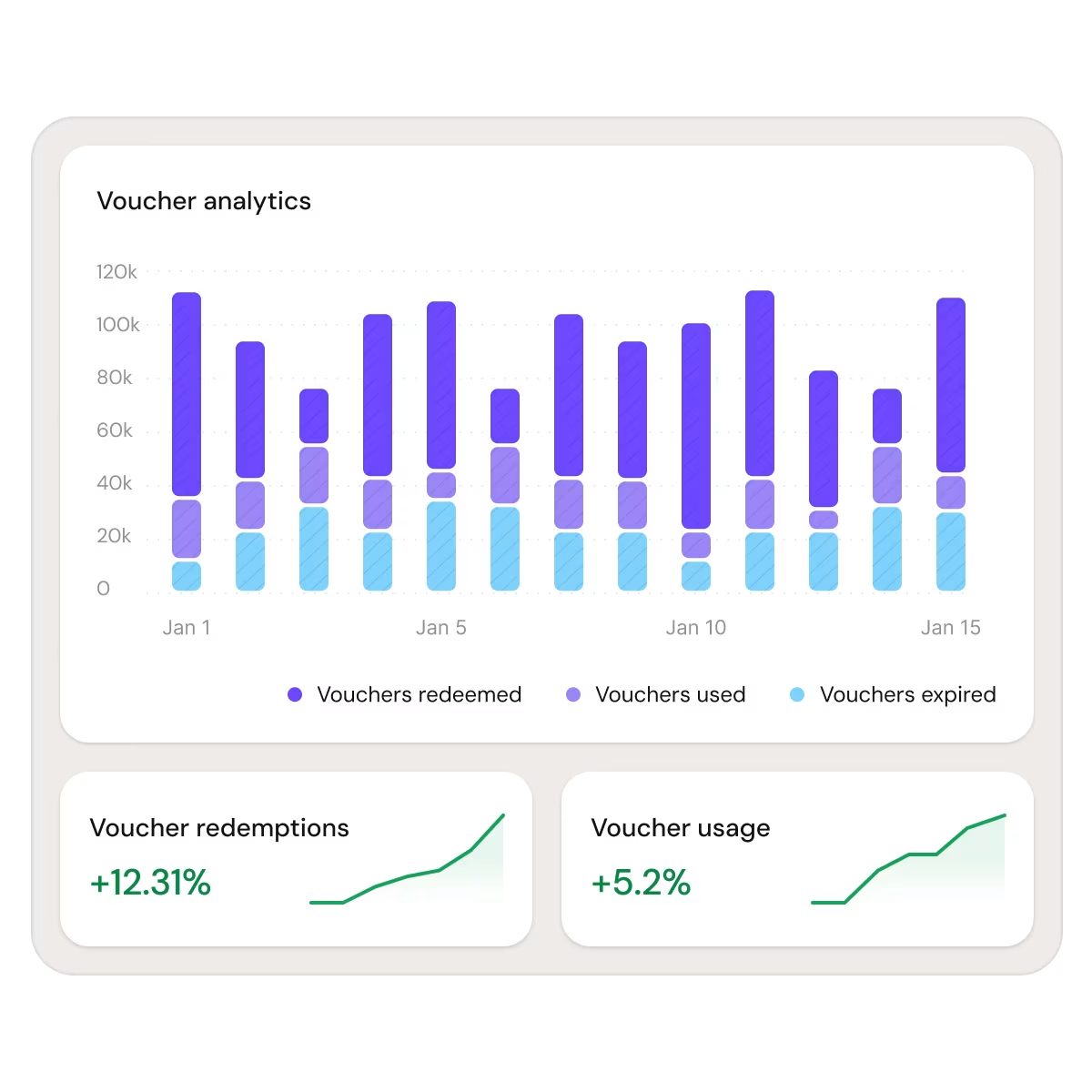
Reporting closes the loop: centralized dashboards that surface redemption and issuance data by channel let a CRM lead manage campaigns, track performance metrics easily, and review insights on redemption rates, customer behavior, and campaign performance across voucher products before unredeemed value erodes program margin.
Real-time monitoring of voucher transactions also gives organizations better financial control.
By analyzing purchasing behavior, the system supports faster targeted marketing campaigns.
The build-versus-buy decision for a voucher management system usually reduces to three models: custom build, legacy SaaS, and an API-first architecture. Each carries a different total cost of ownership curve, and the gap widens once a program needs a multi-country rollout rather than a single-market launch, because automation improves operational efficiency when voucher-related processes move from manual work into the engine.
For programs already running one market and evaluating a second or third, the API-first engine consistently wins on total cost of ownership.
That holds once you price in the engineering hours a custom build demands and the renegotiation cycles legacy SaaS vendors impose at renewal. Industry benchmarks compiled from Gartner and Forrester research put annual maintenance on a custom-built enterprise application at 15-20 percent of the original build cost, rising to 20-40 percent as the system matures (Savi, 2026). That range lands hardest on voucher lifecycle management, where expiration rules and fraud prevention controls need constant tuning.
Role-based access control and audit logging are usually the biggest driver of that gap: a custom build has to construct both from scratch, where an API-first engine ships them as configuration.
A voucher management system earns its budget differently in each vertical. Retail leans on gift card management and expiration rules for supermarket chain customers. Telecom depends on multi-country rollout logistics. Hospitality lives on digital wallet redemption at the front desk.
Telecom operators running loyalty vouchers across nine or more markets need one system, not nine local workarounds. Globally, 62 operators have deployed voucher management solutions.
A single voucher management system (VMS) with role-based access control lets a regional CRM lead set country-specific expiration rules while headquarters keeps one reporting view across all markets. Open Loyalty's work with Circles.Life, a digital-native telecom brand, follows that pattern: one gamified loyalty programme running across markets instead of a patchwork of regional builds. Bringing dealer management, eTopup, and other core functions together on one platform helps teams respond faster across the sales and distribution value chain. In telecom, that kind of setup also helps operators manage subscribers more consistently across markets. After voucher-sales optimization, some operators reported a 16% increase in yearly transactions. Voucher optimization also drove a 308% increase in agents using mobile money.
Hotel groups issue digital wallet vouchers, Apple Wallet, Google Wallet, for perks like room upgrades and spa credit. These redeem at check-in through webhook-based integration with the property management system.
Guests never dig through email; the voucher just sits in their wallet, with a PIN-protected code if the property wants added verification.
Banking and airline programs carry the heaviest compliance load. According to PCI SSC, any system that stores or transmits card-linked voucher data falls under PCI DSS scope, and the underlying technology now processes 30 billion transactions annually at global scale.
That is why fraud prevention controls and SOC 2 verification matter more here than in a single-market retail rollout.
The VMS dashboard's reporting tabs typically surface redemption data by market and channel, so a Head of CRM can see order-of-magnitude differences between programs without exporting anything.
Voucher contents, denomination, expiry, wallet type, functions, and sync automatically once configured, and a VMS supports both digital and physical vouchers, including physical vouchers. Redemption itself can take under a second at checkout when the integration is built correctly.
A voucher management system (VMS) handling prepaid value must clear PCI DSS compliance before it touches a single card number or voucher PIN. Strict controls are needed to ensure system integrity during voucher PIN generation. Skip that step and a multi-country rollout stalls at the first banking partner's security review.
According to the PCI Security Standards Council, any system that stores, processes, or transmits payment card data must complete a Level 1 through Level 4 validation depending on transaction volume, with Level 1 merchants requiring an annual on-site assessment. Use this overview as a pre-procurement checklist, not a post-signature audit.
PCI DSS compliance: tokenized PIN storage, encrypted redemption tracking, network segmentation between voucher order data and cardholder data.
Fraud prevention controls: redemption rate-limiting, anomalous order-pattern flags, unique codes, expiration dates, redemption limits, and a full voucher lifecycle management log for retroactive audits.
Operational best practices strengthen system security. These controls matter at the scale of more than 30 billion voucher transactions processed annually.
Role-based access control: separate admin tabs from viewer tabs so store or call-center staff can see redemption reports without editing voucher expiration rules.
GDPR: data residency options for each multi-country rollout market and a documented right-to-erasure workflow.
SOC 2: request a current Type II report, not a self-attestation, and confirm webhook-based integration logs sit inside the audit scope.
Before signing, take one more step: ask what compliance updates cost after year one. Vendors billing every PCI DSS re-certification separately raise total cost of ownership and signal vendor lock-in risk that an API-first architecture is built to avoid.
Integrating a voucher management system (VMS) with CRM, customer data platform (CDP), and eCommerce stacks works best through webhook-based integration rather than nightly batch syncs. A webhook pushes voucher-state changes, issued, redeemed, expired, to your CRM the moment they happen, so a support agent sees a customer's real redemption tracking history instead of yesterday's snapshot.
The risk to flag for procurement: webhook delivery can fail or duplicate on a flaky network. A VMS built on idempotency keys prevents a retried webhook from crediting the same voucher twice into your CDP, which matters when finance reconciles order-level voucher liability at month-end.
Integration complexity consistently ranks among the top reasons enterprise loyalty teams miss their launch date for a new rewards program.
This is also where vendor lock-in risk gets decided. An API-first architecture with documented webhooks and open reporting endpoints lets you swap the eCommerce platform or CDP later without rebuilding the VMS. A closed, monolithic system ties your total cost of ownership to one vendor's roadmap, worth pricing out before contract signature, not after. That's what played out at USSF (US Soccer Federation), where an API-integrated fan-engagement programme issued more than 60 million loyalty points without a platform rebuild.
Evaluating a voucher management system vendor starts with two non-negotiables: how tightly they enforce role-based access control, and whether their platform treats voucher lifecycle management as a native workflow that can also personalize vouchers for different audience segments rather than a bolt-on module. A vendor that treats redemption tracking, expiration rules, and reissuance as separate tools is signaling future integration debt, which makes it harder to respond to customer needs. Ask, too, whether administrators can manage multiple products without adding manual work.
PCI DSS 4.0, published by the PCI Security Standards Council, spans 12 requirement categories, and Requirement 7 specifically mandates role-based access control for any system touching voucher or payment data. Ask for the SOC 2 Type II report directly, not a sales summary.
We recommend scoring each vendor against this table before any procurement call, not after.
A voucher management system issues and tracks single-use codes; a loyalty platform manages ongoing points, tiers, and referral programs. Open Loyalty layers voucher management on top of tier logic, while a standalone VMS has no points engine. Choose a VMS alone only if vouchers are the entire program.
Telecom operators need a voucher management system built for high-volume, PIN-based prepaid top-ups, not gamified loyalty mechanics. In telecom workflows, distributors can bulk-return unsold vouchers through the VMS. Telecom teams also use it to track inventory and expiration dates, identify slow moving inventory, prevent stockouts, and manage expirations effectively. Quick receipt and redemption of digital vouchers can help improve the subscriber experience. Look for fraud prevention controls and role-based access control sized for call-center and retail-agent issuance.
Digital voucher management system pricing usually runs on a per-active-voucher or per-transaction fee rather than a flat license. Enterprise-grade platforms typically range $1,000-$10,000+/month depending on volume and features, with custom-app tiers starting around $400-$1,500/month (RaftLabs, 2026). Budget separately for integration work and custom reporting.
A handful of open source voucher management system projects exist, but most lack fraud prevention controls and vendor support for multi-country rollout. Total cost of ownership often beats a commercial API-first architecture only on paper. Weigh vendor lock-in risk against in-house maintenance before committing.
Electronic voucher management system integration runs through webhook-based integration and REST APIs pushing redemption events to your CRM, POS, or CDP in real time. A stable VMS confirms idempotency on each webhook call so a retry never double-redeems a voucher.
A prepaid voucher management system needs PCI DSS-aligned controls, role-based access control, and fraud prevention controls such as velocity limits on redemption attempts. According to the PCI Security Standards Council, PCI DSS 4.0 became mandatory in March 2026 and requires stored-value systems to meet card-processor-level data protection. Verify SOC 2 Type II reporting first.
A hotel voucher management system commonly issues spa, dining, or upgrade vouchers tied to loyalty tiers, with voucher expiration rules set per property or season. Redemption tracking at the point of sale shows which vouchers guests actually take up before they lapse.
An API-first architecture replaces rip-and-replace migrations with a phased rollout you control, connecting redemption tracking, fraud prevention controls, and role-based access control to your existing CRM and eCommerce stack through webhook-based integration rather than a rigid vendor overview screen.
Before committing budget to any voucher management system, model total cost of ownership against vendor lock-in risk, not just license price. A multi-country rollout with clear voucher expiration rules exposes weak reporting and brittle tabs fast.
Want a second opinion on your current voucher management setup, order data model, or reports pipeline? Talk to our team and book an architecture review.

API-first loyalty and gamification engine

Get a weekly dose of actionable tips on how to build and grow gamified successful loyalty programs!