See which SKU performs better – and cap what each costs


Two months after launching Product Catalog, Open Loyalty now shows loyalty teams how each product performs in the program and what the points awarded for it cost.
New per-product limits and rule clubbing let teams promote specific products with a high reward and a ceiling they set in advance.
The problem
Product-level rewards are standard practice in retail and CPG loyalty programs, and every product promotion raises two questions for the team running it.
The first is cost: does the product's margin still cover the points given away for it? Answering that usually means matching transactions, product costs and the value of a point in a spreadsheet, often every month.
The second is control. A generous reward on a fast-selling product can use up a campaign budget in days, and a purchase covered by both a category rule and a product rule can earn more than the team planned.
The solution
A new Analytics view shows revenue, items sold, loyalty cost and margin after loyalty for every SKU, category and brand, broken down by sales channel and by the tiers and segments members held when they bought.
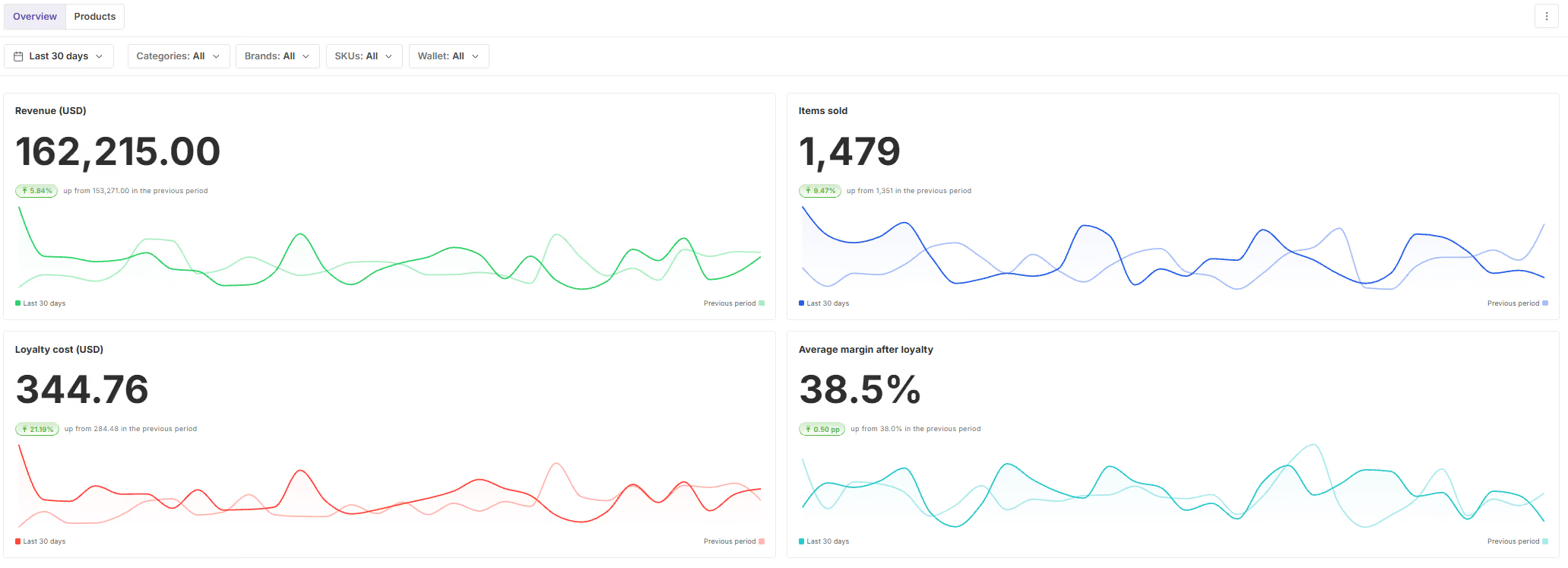
To calculate loyalty cost, teams set the average cost of a point for each wallet, and Open Loyalty converts the points attributed to each product into money.
One screen then shows which products earn money once the program's cost is included, and which lose it. When finance corrects the value of a point, past reports recalculate automatically.
Per-product caps
In campaigns, each rule can now cap the reward per product: a maximum number of units or points, per product or shared across a category, per member or across all members, for the whole campaign or renewed every day, week, month or year.
The purchase always goes through, and the member doesn't earn above the cap.
Rule clubbing sets what happens when one purchase matches several rules in the same campaign, so rewards either stack or come only from the first rule in the campaign's order.
Real-life use cases
Finding products that lose money on points
A loyalty manager compares margin after loyalty across SKUs, spots a bestseller whose margin turns negative once the cost of points is subtracted, and lowers that product's reward in the campaign.
Pain points addressed: product margins eroded by points without anyone noticing until a spreadsheet review.
Preparing a co-funding conversation with a brand
Before a quarterly supplier meeting, the team filters the analytics by the supplier's brand and reads revenue, items sold and loyalty cost for its products, which gives them a basis for discussing who funds the points.
Pain points addressed: brand-level loyalty cost assembled by hand before supplier negotiations.
Closing the financial year
When finance sets the final value of a point for the past year, the loyalty manager updates the cost per unit and every report for that year recalculates, with no corrections in spreadsheets.
Pain points addressed: manual spreadsheet corrections when the value of a point changes at year end.
Sharing a fixed budget across retailers
In B2B and distribution programs, one large retailer ordering 100 units could use up a campaign's whole points budget. A per-member limit on each product shares the same budget among many retailers, so more of them benefit.
Pain points addressed: one large buyer using up a fixed campaign budget.
Promoting a new product with a high reward
A retailer can give 25 points per piece on a new jacket and cap it at 5 pieces per member for the whole campaign, so the promotion's cost stays predictable even when some members buy in bulk.
Pain points addressed: unpredictable cost when members buy a promoted product in bulk.
A special offer inside a category campaign
A campaign can give 10 points per item in the "Outdoor" category and 25 points per piece for one jacket model. With clubbing off and the jacket rule placed first, a member buying the jacket earns 25 points per piece, while other Outdoor products still earn 10.
Pain points addressed: overlapping category and product rules paying twice for the same purchase.
"[Draft – Natalia to approve] Rewarding members for shopping is the easy part – understanding the impact of those rewards on the business much harder. But it's essential to optimize the program's returns.
Open Loyalty makes it easy by letting loyalty managers know what each reward costs and put a ceiling on it before the campaign starts."
Natalia Kalkowska, Product Manager
Getting started
The features are already available to all Open Loyalty clients. New clients can book a demo at openloyalty.io.
Add category, brand and unit cost to your catalog and set the cost of a point per wallet to unlock margin reporting.
Learn more about how to use the feature in the Product Analytics documentation page.
About Open Loyalty
Open Loyalty is the loyalty technology platform for enterprises building high-performance programs. Every year, Open Loyalty helps generate $4B+ in revenue through gamified loyalty programs. Heineken, JTI, INTERSPORT, ALDO, and hundreds of enterprises from 35 countries use its composable, API-first architecture to integrate loyalty and gamification mechanics without building from scratch.
Open Loyalty is part of the OEX group – 15 companies, 4,000+ employees, €225 million in revenue in 2025. Google, Deloitte, and Gartner have recognized Open Loyalty for the scalability of its technology and readiness to support enterprise customers.

API-first loyalty and gamification engine