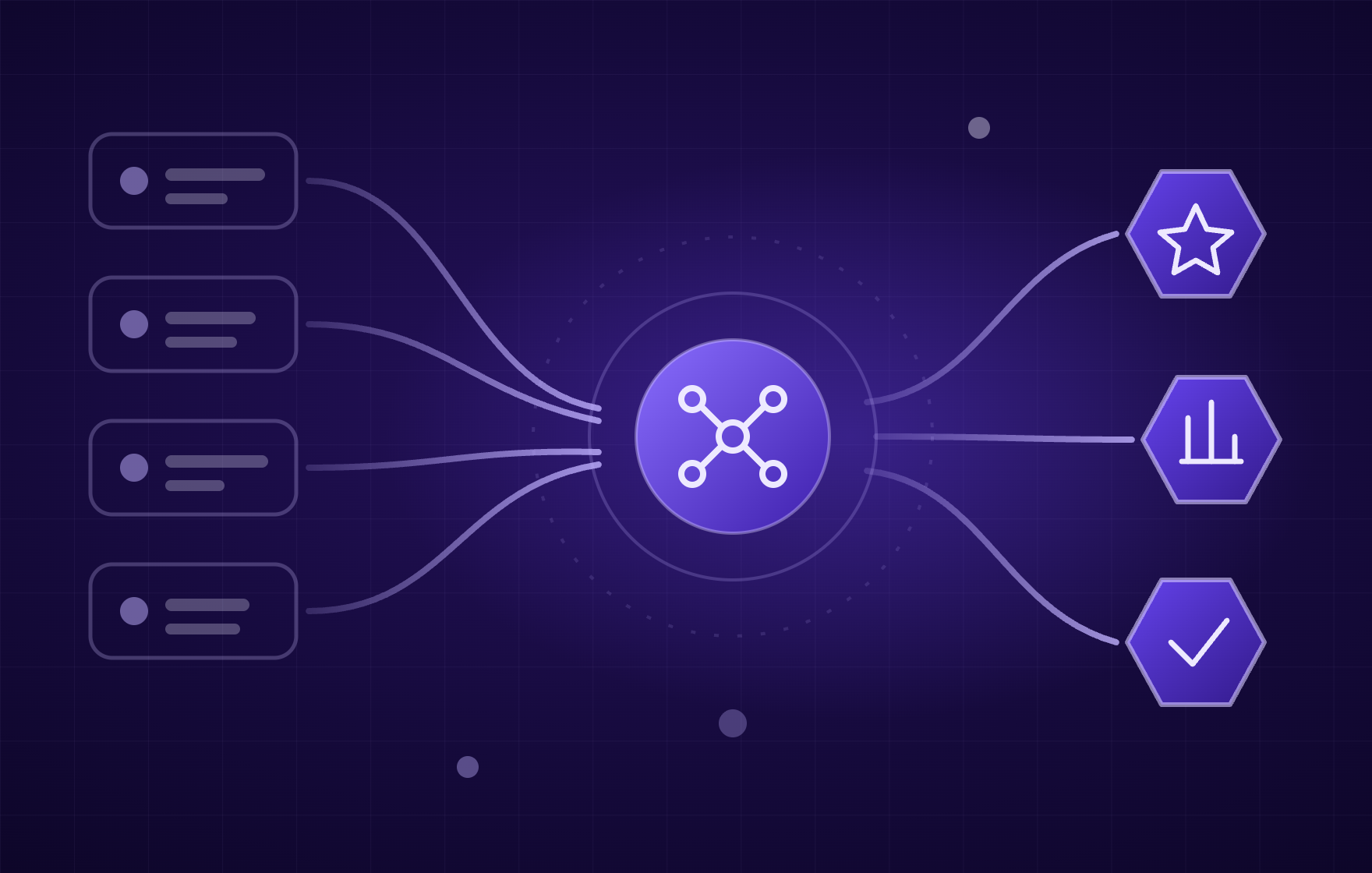
Hyper personalization in loyalty is a different architecture: behavioral and transactional AI models score each member individually, predict the next-best action and next-best reward most likely to move that customer, and update those predictions as new events arrive instead of assigning fixed rewards to a cohort.
For loyalty program teams, CRM leaders, and the marketing and analytics owners of rewards and engagement strategy, that shift changes what your data stack, operating model, and risk profile look like. The payoff is higher program effectiveness and ROI—through more relevant rewards, stronger redemption, and higher customer lifetime value than segment-based approaches typically deliver in retail and ecommerce loyalty. Here's what changes when you move from tier-based rules to model-driven decisioning: the role of AI, the data and operational requirements, how to measure success, where fatigue and privacy risks show up, and what adoption actually costs.
Tier-based personalization assigns rewards by cohort. Hyper-personalization scores each customer one at a time, using a behavioral/transactional model instead of static segment rules. That distinction changes almost everything about how a loyalty program runs day to day.
A tier-based personalization scheme puts a customer in "Gold" or "Silver" and hands the same offer to everyone in that bucket, refreshed quarterly at best.
Individual-level inference instead runs propensity modeling against each member's transaction and behavioral history to predict which reward, channel, and moment will move that specific customer - closer to next-best-action scoring than segment logic, and specific enough to support next-best-reward prediction rather than a fixed benefits table.
Getting this right is central to improving loyalty personalization, since the reward and channel selected for each member directly determine program ROI.
According to McKinsey's research on personalization economics, companies that excel at personalization generate 40 percent more revenue from those specific activities than average performers. Many loyalty teams read that as license to bolt AI onto existing tiers.
That's the wrong read - hyper-personalization is a different decisioning architecture, not tiers with a model attached. This distinction matters most in ecommerce loyalty rewards programs, where reward relevance directly drives repeat purchase behavior.
Open Loyalty's platform team has run propensity-based reward models against rules-based control groups in live loyalty deployments, tracking redemption-rate and average order value (AOV) lift at production transaction volume.
What that work exposes, consistently, is a tradeoff few programs price in upfront: a model needs continuous feedback loops and engineered features a rules engine never asks for, and running one costs real operating budget, not just a one-time build.
That tradeoff becomes even more pronounced when you consider how rewards are managed operationally, since propensity models must integrate with reward allocation, redemption logic, and budget controls in ways rules engines never had to.
This piece maps that operational difference, what it demands from your data and team, and where it breaks - personalization fatigue, over-fitting on short-term signals, the cold-start problem, and total cost of ownership.
Next-best-action scoring answers a different question than a rules engine does: not "which segment is this customer in," but "what single action, right now, maximizes this specific customer's response." A rules engine walks a fixed decision tree: if tier equals Gold and month equals birthday, then send 20 percent off.
Next-best-action scoring recalculates a probability for every possible action, using real time data every time a customer transacts, browses, or opens an app so scores update across touchpoints. It works the same way across customer service interactions as it does for marketing offers, scoring relevant next steps rather than applying one static rule to everyone in a tier.
Next-best-reward prediction is the loyalty-specific application of that scoring. Instead of choosing a channel or message, the model ranks which reward, points multiplier, early access, a specific product discount, or a challenge, has the highest predicted redemption probability for that individual, based on their transaction history, past purchases, and stated preferences.
This is propensity modeling applied to reward selection rather than churn or upsell. It represents a step beyond traditional segmentation strategies, which typically group customers into broad tiers rather than scoring tailored rewards for each individual across their entire purchase history.
The operational cost differs sharply. A rules engine's decision tree is cheap to build and cheap to maintain, a marketing team edits thresholds in a dashboard.
A next-best-reward model needs continuous retraining, predictive analytics to anticipate likely responses, an analytics pipeline feeding transactional data in near real time, and someone monitoring for drift when customer behavior shifts. That ongoing maintenance is the real price of a tailored experience, not the initial build.
That revenue gap assumes the model is fed and maintained on an ongoing basis, not deployed once to deliver a single tailored campaign and left alone.
New members create a cold-start problem: no transaction history means no signal for the model to score against, whether for product recommendations or customer service prioritization. Most loyalty deployments handle this with a hybrid fallback: rules-based defaults until enough behavioral data accumulates, then a handoff to model-driven scoring.
This cold-start problem is especially acute in shared multi-brand coalition programs, where new members may already carry behavioral signal from partner brands and products but the model has no direct history of its own to draw on.
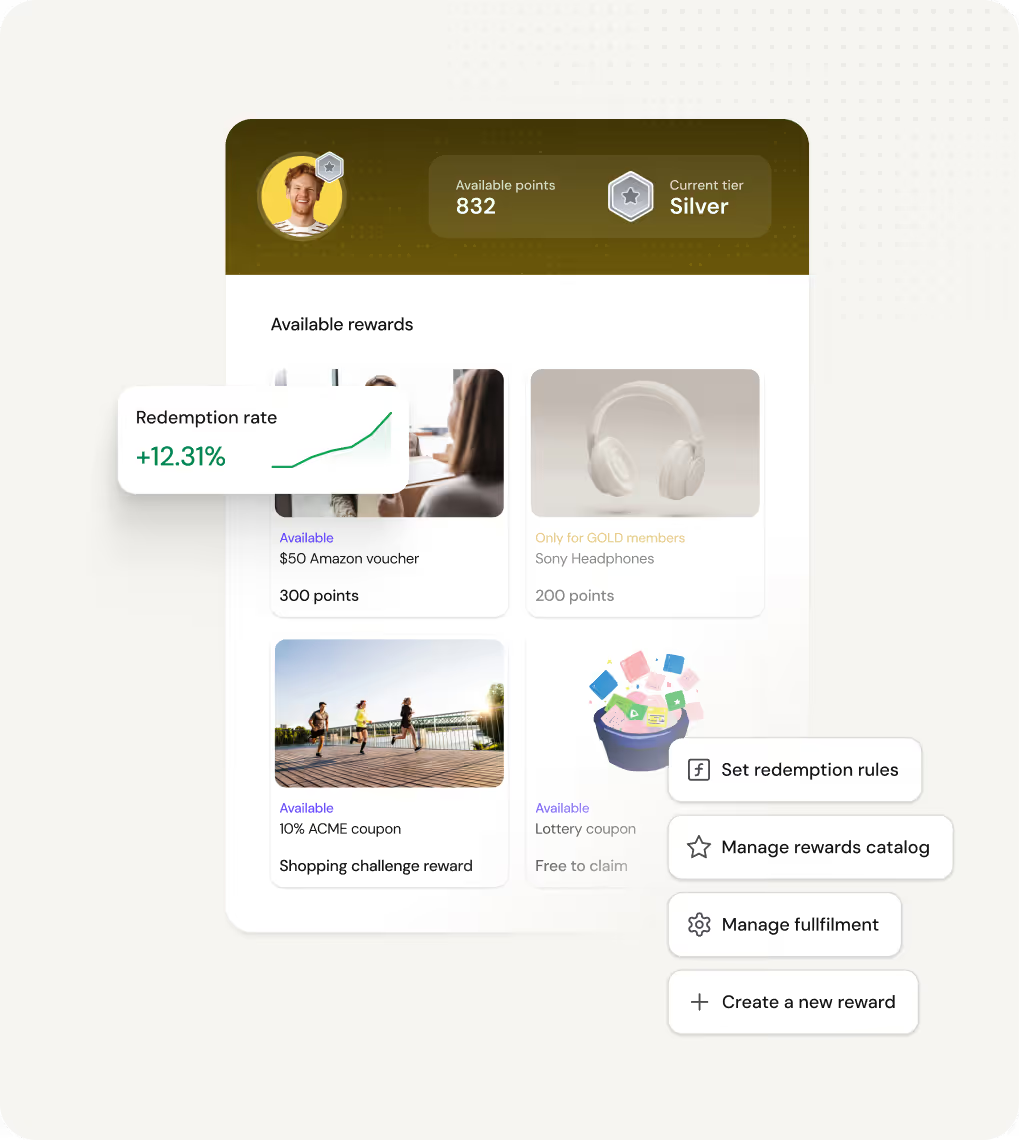
Propensity modeling replaces the fixed reward table with hyper-personalized rewards per member: the probability that a specific offer, at a specific moment, moves a specific member's next purchase.
A fixed tier gives every Gold member the same 20 percent voucher regardless of whether that member is price-driven or frequency-driven.
Propensity-based dynamic rewards assign a different reward type to each, because the underlying customer lifetime value (CLV) impact of a discount versus a free-shipping perk versus early access varies by individual preferences, not by tier.
The cost trade-off is real. A rules engine needs an analyst and a spreadsheet; a propensity model needs a feature store, retraining cadence, and someone who can diagnose model drift when redemption rates drift from what the model predicted.
In practice, most propensity-based programs blend a thin rules layer for the first 30 to 60 days before individual-level inference takes over — the same cold-start bridge covered above, just with a concrete timeframe.
Whatever the lift, it has to cover the added operational cost of running two systems during the handoff window, or the model isn't paying for itself yet, unlike a static point collection system where fixed benefits are inherently limited.
Real-time decisioning means a behavioral/transactional model scores each member's next action as new transaction data arrives rather than on a batch schedule. A static trigger, run through a rules engine, fires only when one predefined condition is met - "member crosses 500 points," "cart abandoned 24 hours." A behavioral/transactional model recalculates next-best-action scoring and next-best-reward prediction continuously, weighing dozens of signals instead of one.
The cost line matters more than teams expect. Running a rules engine costs almost nothing per request. Running a propensity model at transaction volume means retrieving features and returning a scored decision inside the checkout or app session, typically within a low-hundreds-of-milliseconds budget before a customer notices lag.
That compute and engineering overhead is the real total cost of ownership question CRM leaders should weigh against expected redemption-rate or AOV lift, not just licensing cost. The same cold-start bridge applies here: tier-based personalization for the first few sessions, then a handoff once signal density is sufficient — a pragmatic workaround, not a permanent one.
A propensity model needs clean, usable event-level history and a live feedback loop; that’s where data powers hyper personalization for decisioning, while a rules engine needs neither. That's the operational gap hyper-personalization opens up once a program moves past tier-based personalization.
A rules engine checks a static condition against an aggregate count - points crossed 500, cart idle 24 hours. Next-best-reward prediction runs on individual-level inference instead, which means the model needs a record of what one customer actually did, transaction by transaction, not which segment they were assigned to.
That history has to live somewhere queryable at decision time. Most propensity-based reward deployments we've built pull this from customer data platforms that unify behavioral, transactional, and preference signals per member, with unified customer data allowing the model to score consistently under the same data privacy rules that govern any customer-level profile, then expose it through a feature store the model reads live. Many organizations struggle with fragmented or inconsistent data, which weakens data quality and model performance. By 2026, 80% of enterprises will adopt customer data platforms.
Three things a rules engine skips entirely: labeled outcomes - a record of which past next-best-action offers actually converted, so the model has something to learn from; a feedback loop that feeds every accepted or ignored reward back into retraining; and cold-start handling, where a new customer with no transactional history gets scored on population-level priors for their first few purchase events, not personalized ones.
None of this is free. ML model maintenance & retraining: 15-25% of initial build cost annually (Tensoria, 2024). Most martech teams underestimate the ongoing data-engineering and monitoring cost of a live model in practice, budgeting for it as a one-time build rather than a maintained product.
Budget for an owner on retraining cadence and drift monitoring - the real cost shows up in headcount, not licensing.
A feedback loop is the piece a rules engine never needed and a propensity model cannot run without. Every next-best-reward prediction generates an outcome - redeemed, ignored, unsubscribed - and that outcome becomes a new training label. Without it, the model stops learning and starts guessing based on stale behavior.
That dependency is also where the operational cost lives, and to implement hyper personalization effectively, teams need more than a model - they need process and ownership. A rules engine needs a business analyst to adjust a threshold a few times a quarter. A behavioral/transactional model needs scheduled retraining, a monitored feature store, and someone watching for model drift - the gradual decay in next-best-action scoring accuracy as customer preferences shift away from the patterns the model was trained on - because AI and machine learning only work reliably when that operating layer is in place.
We've observed this directly running propensity-based reward scoring at transaction volume: drift shows up first in individual-level inference for high-frequency customers, whose behavior moves faster than the retraining cadence assumes. Implementing hyper-personalization requires robust technology infrastructure. This is the kind of evidence that should sit behind any TCO comparison, not a vendor's uplift claim taken at face value.
Sustained investment is what separates a working deployment from an abandoned one: Gartner's AI maturity survey found 45% of organizations with high AI maturity keep AI projects operational for at least three years, versus just 20% of low-maturity organizations. Budgeting for a model, in practice, means budgeting for two systems, not one — the model, and the cold-start fallback that covers it until enough data accumulates.
AI supplies the individual-level inference layer that a rules engine cannot compute on its own, making hyper personalization strategies possible through propensity modeling for next-best-reward prediction, and increasingly, uplift modeling and reinforcement learning to decide not just what a customer wants, but what action actually changes their behavior.
Propensity models answer "will this customer redeem?" Uplift modeling answers a sharper question: "will offering this reward cause a redemption that would not have happened anyway?" That distinction matters for margin. A model that scores propensity alone will happily discount customers who were buying regardless, eroding AOV for no incremental gain.
Reinforcement learning pushes further, treating each next-best-action decision as part of a sequence rather than a one-off prediction.
Instead of optimizing a single reward event, an RL policy learns which offer sequence maximizes retention and CLV over months, adjusting as the feedback loop returns new outcomes.
According to McKinsey's research on AI-driven personalization, businesses that deploy this kind of behavioral, data-driven personalization see revenue gains of 10 to 15 percent versus segment-based approaches, and hyper personalization enables businesses to keep adapting decisions to each customer over time.
This is where hyper-personalization diverges structurally from tier-based personalization and traditional personalization. A rules engine encodes what marketing teams already believe about customer preferences. Uplift modeling and reinforcement learning let the transactional model discover what actually drives behavior, then keep revising that belief as new customer data arrives.
Measure hyper-personalization against a control group, not against last year's baseline. The key performance metrics that prove a propensity model earns its keep are incremental lift in redemption rate and customer lifetime value (CLV) versus a rules engine running the same offer catalog on a matched cohort.
Three metrics matter more than the rest. Hyper-personalization can lift customer engagement by over 20-30%. Redemption rate tells you whether next-best-reward prediction is actually matching offers to preferences, not just to segment averages. CLV tells you whether that match compounds into retention rather than a one-time spike. AI-driven personalization can increase conversion rates by 20-30%.
Cost-to-serve tells you whether the feature store, retraining pipeline, and model monitoring are cheaper than the lift they generate, which is the total-cost-of-ownership question most teams skip until year two. In fact, 86% of companies report a measurable business boost from personalization.
That revenue gap has to be wide enough to justify the added engineering cost, and only a disciplined feedback loop on attribution tells you whether it actually is.
Watch two failure modes when reading the dashboard. A model that looks strong in week one but decays by month three is likely overfitting to short-term transactional noise rather than durable preferences. And new members will show flat lift regardless of model quality, since individual-level inference has no signal to work from until the cold-start period closes, usually after three to five transactions.
Hyper-personalization introduces three risks a rules engine never carried: personalization fatigue, overfitting on short-term signals, and a privacy backlash that can undo the lift a propensity model generates in a single news cycle.
Fatigue sets in when next-best-action scoring pushes offers at a cadence the member never asked for.
A behavioral/transactional model that fires on every session, rather than on meaningful state change, trains customers to ignore the channel entirely across every touchpoint. Over-messaging, not under-personalizing, is the more common cause of disengagement in mature CRM programs because it violates customer expectations around frequency and relevance. Tier-based personalization rarely triggers this because cadence is capped by design.
Individual-level inference has no such ceiling unless you build one in, and personalized experiences still need cadence controls to avoid fatigue.
Overfitting happens when a propensity model reads a single anomalous purchase, a gift, or a one-off bulk order, as a durable preference and recalibrates next-best-reward prediction around it. A member who buys running shoes as a one-time example of gift-giving shouldn't be reclassified as an athlete overnight.
The fix is a feedback loop with a decay window long enough to distinguish habit from noise, typically 60 to 90 days of transaction history before a signal earns weight. Skip that window and the model chases last week's customer, not this year's.
Good analytics infrastructure uses data analysis across multiple data points to catch this drift before it reaches the member experience. A ruleset never needed that safeguard because it never inferred intent in the first place.
Creepiness is a data governance failure before it is a modeling one.
55% of consumers will stop engaging if personalized communication feels invasive (Gartner Digital Marketing Strategy, 2025). Individual-level inference must stay inside what the customer has knowingly disclosed and consented to.
Anything reconstructed from third-party behavioral exhaust reads as surveillance, not customer service. A relevant, tailored recommendation on products the member already browsed feels helpful; the same recommendation built from data they never shared feels invasive, even when the underlying interactions are identical.
There is also a cost line rules engines don't have. A ruleset needs occasional editing; a propensity model needs monitoring for drift, periodic retraining, and a data science owner to keep it delivering value.
Budget for that total cost of ownership before you commit, not after the cold-start problem forces an emergency fallback to segment rules.
Personalization targets a segment; hyper-personalization targets one customer. Traditional personalization typically sends the same reward or message to each member in a bucket, while a propensity model scores each user's likelihood to respond individually. Choose hyper-personalization once segment rules plateau on redemption rate. Unlike traditional personalization, it adapts to individual signals in motion.
AI and machine learning power hyper-personalization through next-best-action scoring and next-best-reward prediction run against a feedback loop of transactional data. These models can deliver personalized content or rewards per customer in real time, not on a fixed schedule. This lets marketing teams personalize experiences at the moment of purchase intent.
Measure hyper-personalization against a rules-based control group using redemption rate, AOV, CLV lift, and customer retention, not engagement alone. A/B test propensity-driven rewards against a static tier structure over a full purchase cycle. Without a control group, lift claims are unverifiable. Tie these measures back to broader personalization strategies rather than treating them as isolated campaign results.
The main challenges are the cold-start problem, model drift, and the higher operational cost of maintaining a model versus a rules engine. New customers lack the behavioral data a model needs, and weak data quality makes early recommendations harder to handle, so they often default to segment-level rules. Budget for ongoing retraining, not a one-time build. Hyper personalization efforts also fail when teams under-budget for maintenance and governance.
Next-best-action scoring recommends any interaction, including content, service outreach, or a reward, while next-best-offer is narrower, focused only on which product or discount to present. Loyalty programs use both: NBA for engagement, NBO for redemption decisions.
Not every loyalty team needs a behavioral/transactional model on day one. Building and maintaining next-best-action scoring carries real operational cost: a feature store, a feedback loop, and someone accountable for model drift. If that TCO outweighs the AOV lift you're chasing, tier-based personalization remains a sound default.
For the tactical playbook on segment-based personalization, zero-party data capture, real-time triggers, tier mechanics, and first-party data inputs you can use before full modeling, see our guide to improving customer loyalty through personalization.
When your business is ready to move from segments to individual-level hyper-personalization, our team can assess whether your data and volume justify propensity modeling. Talk to our team about what personalized, customer-first decisioning would look like for your program, with embracing data-driven insights enabling that shift from segments to individual-level scoring.

API-first loyalty and gamification engine

Get a weekly dose of actionable tips on how to build and grow gamified successful loyalty programs!