The loyalty management software market has more than 300 options. This guide narrows the field to six platforms worth evaluating in 2026 – from API-first engines built for enterprise customization to plug-and-play tools designed for small businesses – and breaks down what each one does well, where it falls short, and who it is built for.
Loyalty management software is the system that sits between your business logic and your customers' experience. It handles point accrual, tier progression, reward fulfillment, campaign rules, and – increasingly – gamification mechanics like challenges, leaderboards, and games of chance. The right platform makes loyalty a revenue driver. The wrong one becomes an integration headache that your team works around rather than with.
Open Loyalty's 2026 Trends report shows where the market is heading: 59.7 percent of loyalty teams are prioritizing personalization, 44.4 percent are investing in automation, and 42.1 percent of professionals rank gamification as the mechanic with the biggest medium-term impact. These priorities should shape how you evaluate the platforms below. (For a broader overview of customer loyalty platforms, see our separate comparison guide.)
Before comparing vendors, clarify what matters for your business. The loyalty software buyer's guide identifies five evaluation axes that separate enterprise-grade platforms from tools you will outgrow:
Architecture. Is the platform headless and API-first, or does it come with a fixed front end? Headless platforms give you full control over the customer experience but require development resources. Integrated platforms get you live faster but limit customization.
Mechanics depth. Does the platform support points, tiers, referrals, challenges, leaderboards, and games of chance natively – or will you need to bolt on third-party tools for anything beyond basic earn-and-burn?
Integration surface. How many systems (POS, CRM, CDP, ecommerce) does the loyalty platform need to connect with? An API-first platform with documented endpoints and sub-120 ms response times will integrate more cleanly than a monolithic suite with limited connector options.
Pricing model. Usage-based, per-member, per-order, or custom enterprise contracts all behave differently at scale. Model each option at your current volume and at ten times that volume.
Implementation timeline. Self-service API platforms can be integrated by internal teams in weeks. Vendor-led onboarding typically takes months but includes structured support.
Best for: Mid-market and enterprise companies that want to embed loyalty and gamification into existing systems without rearchitecting.
Website: openloyalty.io
Open Loyalty is an API-first loyalty and gamification engine designed for enterprises with complex tech stacks. The architecture is headless – loyalty rules, points, tiers, promotions, and gamification all run as backend services that connect to whatever channels, markets, and business units you already operate.
What it covers: The platform handles points, tiers, challenges, badges, leaderboards, spin the wheel, scratch cards, referral programs, coupons, discount rules, and more. Campaigns can trigger on purchases, app events, social actions, or custom behaviors, with targeting tied to segments, locations, time windows, and product categories.
Gamification is built into the core rule engine rather than bolted on as a separate module – challenges, streaks, and games of chance run on the same infrastructure as points and tiers, so a single campaign can combine multiple mechanics without middleware.
Strengths: The deepest native gamification suite among the platforms reviewed here. Real-time event processing handles throughput at enterprise scale. Multi-market and multi-brand deployments are a core use case, with support for different rules, currencies, and front-end experiences per market. The API layer integrates with POS systems, CRMs, CDPs, and ecommerce backends.
Limitations: The headless architecture requires development resources – teams without engineers or a system integrator will need to plan for front-end build time. There is no pre-built consumer-facing UI; you build (or commission) the experience your brand needs.
Open Loyalty has completed over 100 implementations for brands including INTERSPORT, limango, and ALDO. The platform has been recognized by Google and Deloitte for the scalability of its technology.
What reviewers say: G2 reviewers consistently highlight speed and flexibility.
One reviewer noted: "Time to market, scalability, and support – it allows quick adaptation, adding new rewards, adjusting rules, and integrating with internal tools without heavy development." On the improvement side, some reviewers would like more control over how data is displayed in the dashboard and more flexibility in adding restrictions to campaigns.
Pricing: Custom enterprise contracts.
Best for: Enterprises already running Salesforce CRM that want loyalty inside their existing platform.
Website: salesforce.com/products/marketing-cloud/loyalty-management
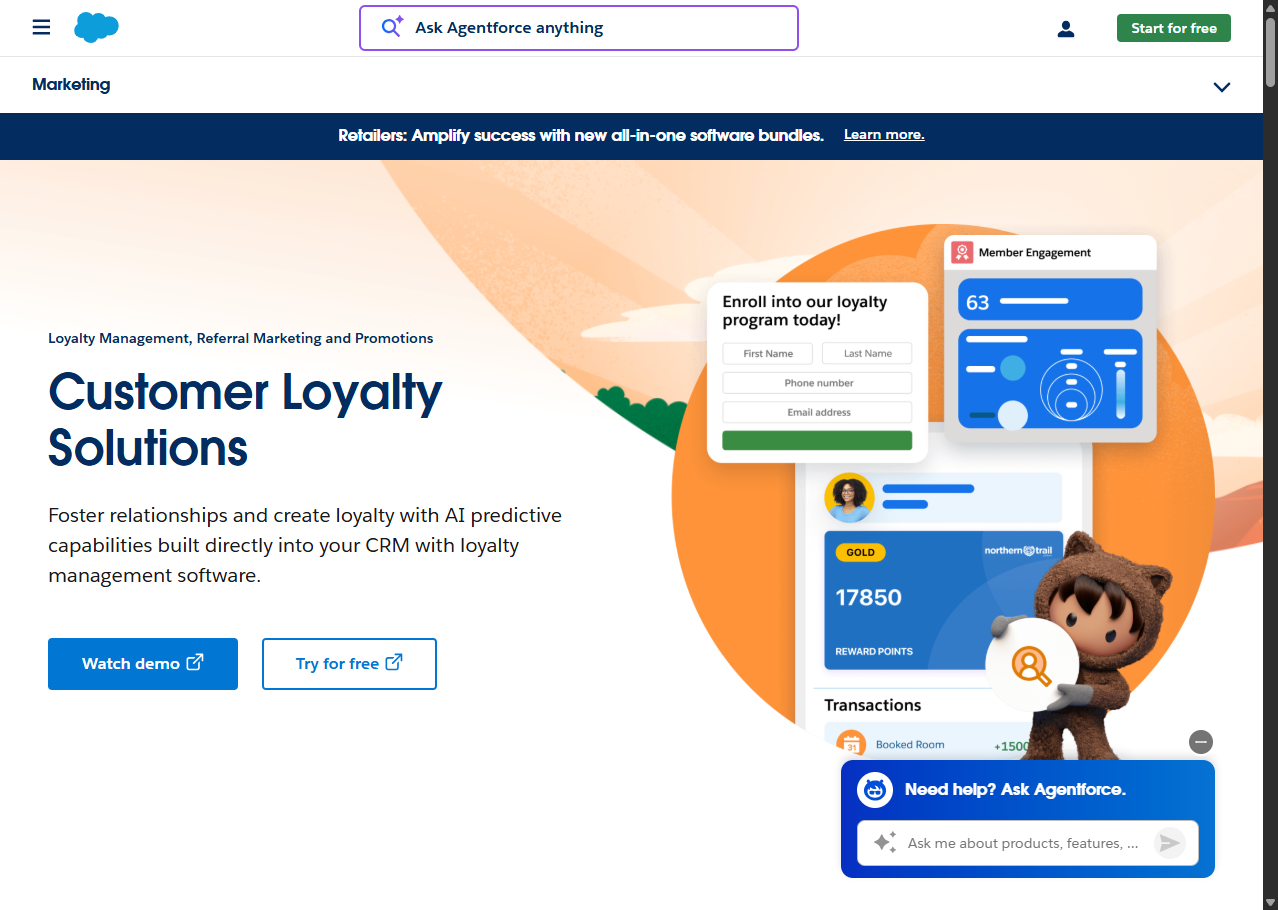
Salesforce Loyalty Management is a module built on the Salesforce platform. It leverages the CRM's existing data model, automation tools (flows, process builder), and integration layer to deliver loyalty functionality within the Salesforce ecosystem.
What it covers: The module supports points, tiers, rewards, referral programs, and partner networks. Loyalty rules can reference any data in the CRM – customer profiles, case history, marketing engagement, commerce data. The partner loyalty network allows coalition-style programs where members earn and redeem across multiple brands. Salesforce has deepened the integration between Loyalty Management and Data Cloud for real-time segmentation based on unified customer profiles.
Strengths: Native access to CRM data means loyalty rules can reference customer interactions across channels without custom integrations. The partner network feature is distinctive – it handles coalition programs that standalone loyalty platforms typically require custom development for.
Limitations: The loyalty module inherits Salesforce's complexity and cost structure. A full enterprise deployment that includes Data Cloud, Marketing Cloud, and Commerce Cloud adds up. Gamification is limited to basic mechanics (points, tiers, badges) – there is no native support for interactive challenges, games of chance, or real-time engagement features like leaderboards and streaks. The architecture is CRM-native, not headless, which means less flexibility for teams that want loyalty as a composable service.
What reviewers say: G2 reviewers appreciate the ecosystem integration. One noted: "It helps teams streamline customer success needs through one area."
However, multiple reviewers flag cost and complexity: "The licensing and implementation costs are quite high, especially for small or mid-sized businesses, and additional costs for CRM, Marketing Cloud, or integrations can add up."
Pricing: Starts at $20,000 per org per month (Starter tier, billed annually), scaling to $35,000 (Growth) and $45,000 (Advanced). Additional costs for Data Cloud, Marketing Cloud, and other platform components.
Best for: Large enterprises in retail, grocery, and fashion – particularly in Asia-Pacific and the Middle East – that want a full-suite loyalty and customer engagement platform.
Website: capillarytech.com
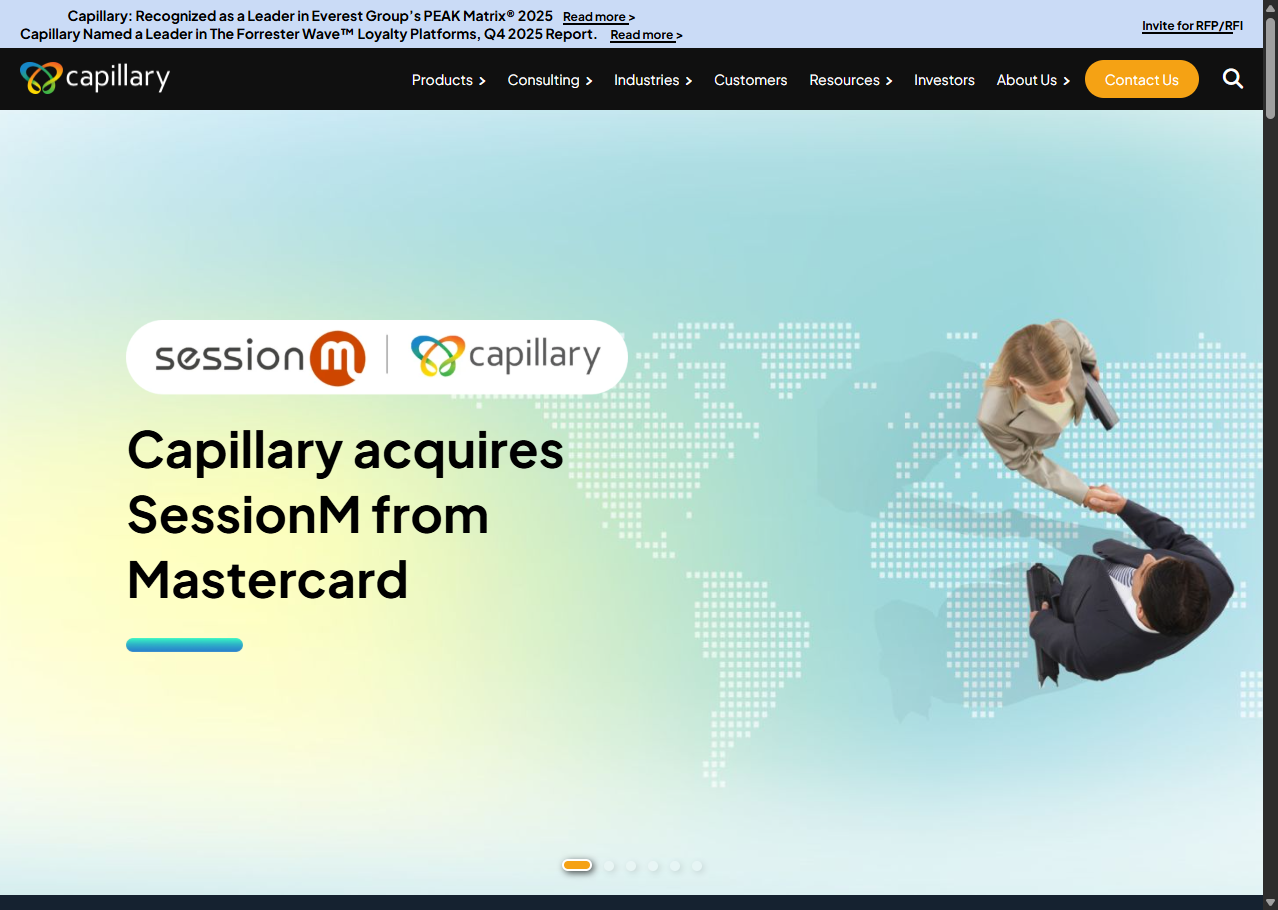
Capillary Technologies offers a suite of products – Loyalty+, Insights+, Engage+, CDP+, and Rewards+ – that cover loyalty management, customer data, engagement automation, and reward fulfillment. The company was named a Leader in The Forrester Wave: Loyalty Platforms, Q4 2025, scoring highest among all 11 vendors in both current offering and strategy categories.
What it covers: AI-led personalization, behavioral segmentation, real-time reward fulfillment, gamified tiering, referrals, surveys, social engagement, and omnichannel customer engagement. The platform includes a Fraud Engine for transaction security and Insights+ for analytics.
Strengths: Strong regional depth in Asia-Pacific and the Middle East, with enterprise clients in retail and grocery. The suite approach means loyalty, CDP, engagement, and rewards are integrated out of the box.
Limitations: The full-suite model means you are adopting multiple Capillary products – which can overlap with tools you already run (CDP, marketing automation, analytics). For companies that prefer a composable architecture where loyalty is one specialized service among many, the bundled approach may introduce redundancy. The platform is more established in APAC than in North America or Europe.
What reviewers say: G2 reviewers highlight ease of configuration. One noted: "Dynamic changes in the tool are very easy and fast to implement." On the downside, reviewers mention that some features can be confusing due to naming conventions, and server issues occasionally prevent configuration failure notifications from reaching users.
Pricing: Starts from $30,000 per year; includes implementation, configuration, integrations, training, and self-service support.
Best for: Ecommerce brands – especially DTC on Shopify – that want loyalty and reviews in a single vendor relationship.
Website: yotpo.com
Yotpo is a retention marketing platform that bundles loyalty with product reviews. In December 2025, Yotpo discontinued its Email and SMS products to focus exclusively on Reviews and Loyalty.
What it covers: The loyalty module supports points, VIP tiers, referrals, and custom rewards. Brands can reward purchases, reviews, social shares, and custom events. The platform offers 20+ out-of-the-box campaign templates, POS integration for identifying loyalty members at checkout, and mobile wallet passes with push notifications and QR redemption.
Strengths: The cross-product integration between loyalty and reviews is the value proposition – if you are already using Yotpo for reviews, adding loyalty means your data flows between modules without additional integration work. Dedicated Customer Success Manager included on higher tiers.
Limitations: Yotpo is built for ecommerce storefronts, not multi-channel enterprise environments. Gamification is limited to points and tiered rewards – there are no native game mechanics, interactive challenges, or real-time features like leaderboards. The December 2025 discontinuation of Email and SMS narrows the platform's scope. Multi-market deployments with different currencies and rule sets are not a primary use case.
What reviewers say: G2 reviewers praise the loyalty-reviews synergy. One noted: "Loyalty and referral programs are robust and easy to configure."
The most common criticism is pricing: "Stores under 500 orders per month find Yotpo too costly, and the free plan is limited with paid plans rising quickly." Some reviewers also report that platform updates occasionally break widgets, requiring ongoing maintenance.
Pricing: Depends on the plan, ranging from $79 per month(Start plan with 500 transactions/month) to custom enterprise pricing.
Best for: Small to mid-size ecommerce brands on Shopify or BigCommerce that want a no-code loyalty program live in days.
Website: smile.io
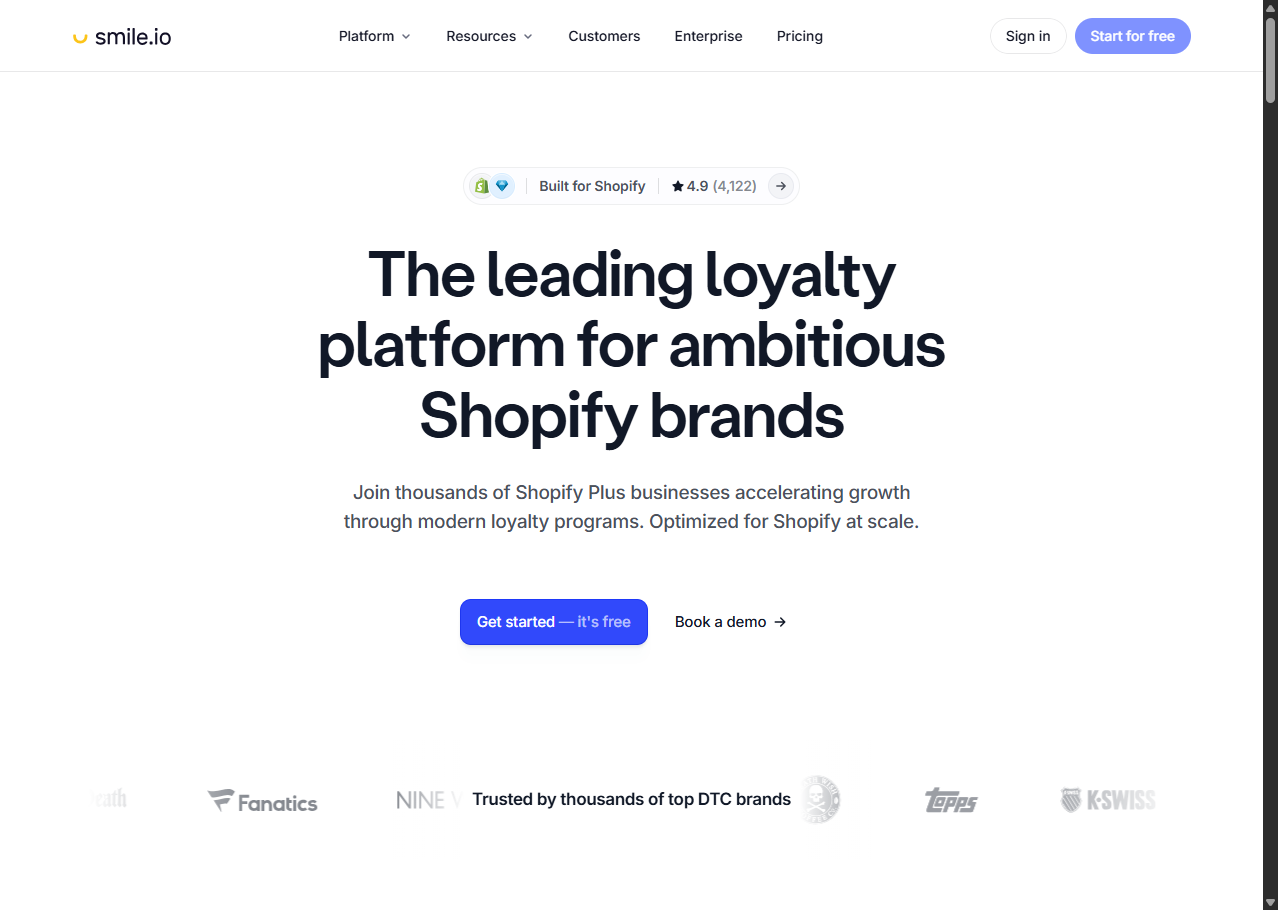
Smile.io is the most popular loyalty app in the Shopify ecosystem, powering programs for over 100,000 merchants. The platform provides points, VIP tiers, and referrals through a branded widget that sits on the storefront.
What it covers: Points for purchases, birthdays, account sign-ups, reviews, and social follows. Redemption options include fixed or percentage-off coupons, free shipping, free products, and Shopify gift cards. The Growth plan and above unlock tiered programs with configurable progression criteria.
Strengths: Speed to launch is the main advantage – a marketing team can configure and go live in days without developer involvement. The widget-based UI handles the front-end experience out of the box. Over 5,000 five-star Shopify reviews signal consistent merchant satisfaction.
Limitations: The architecture is tied to supported ecommerce platforms. Businesses that operate across multiple channels (in-store, app, web, marketplace) or need custom front-end experiences will find the widget-based approach constraining. Gamification is limited to points and tiers – no native game mechanics like spin the wheel, scratch cards, or challenge-based campaigns. Multi-market deployments with different currencies and rule sets are not a primary use case.
What reviewers say: G2 reviewers praise the simplicity. One noted: "Easy to set up and integrates cleanly with Shopify, so you can launch a loyalty program quickly without custom development."
The most common criticism: "Advanced features often require higher-tier plans, which can be a limitation for smaller businesses," and the customer-facing widget offers limited design control.
Pricing: Free plan (up to 200 monthly orders), with paid plans scaling by order volume and feature access.
Best for: Small businesses and single-location retailers that want a simple digital stamp card via Apple Wallet and Google Wallet.
Website: loopyloyalty.com
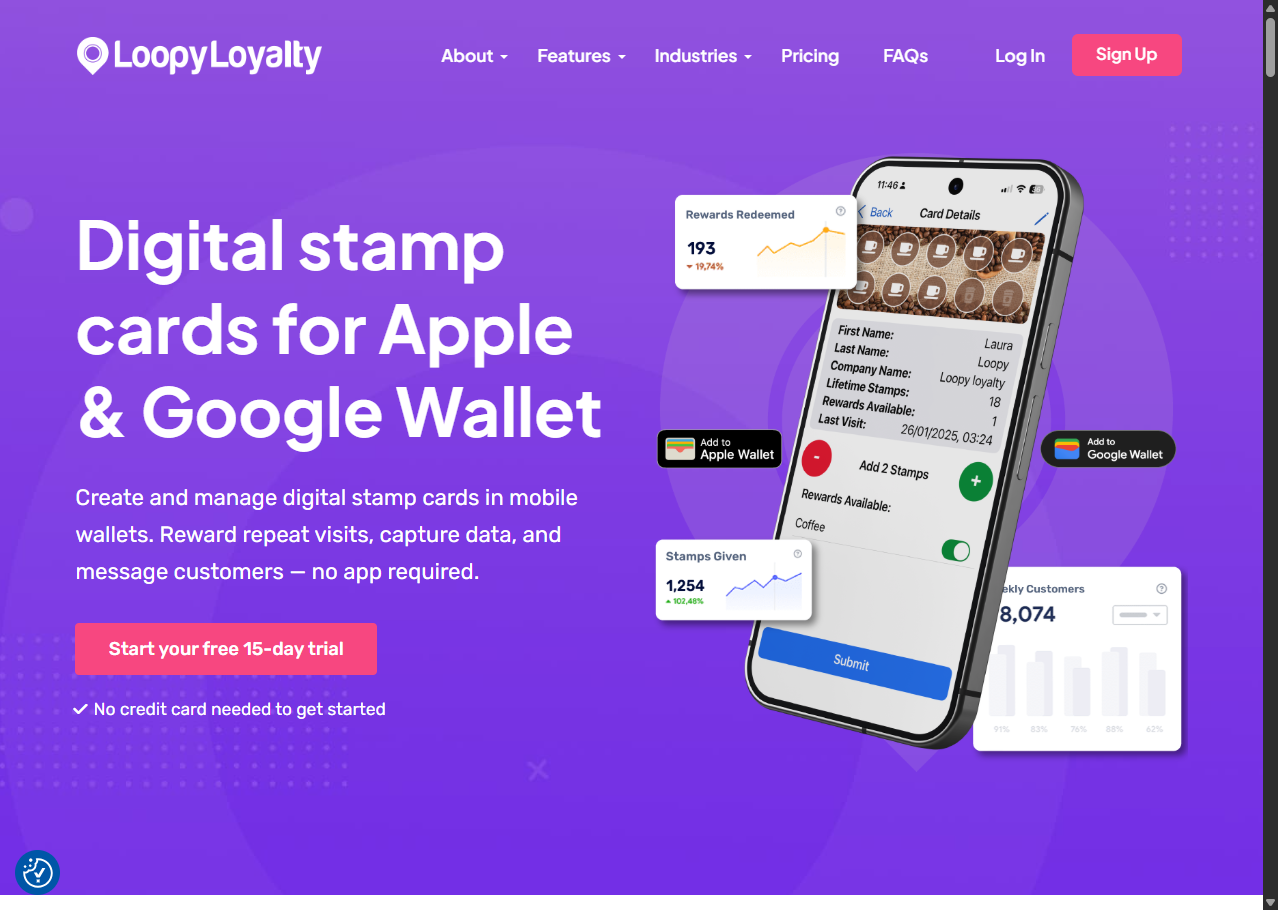
Loopy Loyalty is a web application for creating and managing digital stamp cards. There is no app to download – cards live in Apple Wallet and Google Wallet. The platform targets small businesses that want to replace physical punch cards with a digital equivalent.
What it covers: Digital stamp cards, remote stamp issuance (via the Stamper app or web), location-based notifications (iPhone only), unlimited customers, unlimited push messages, and real-time tracking of stamps and redemptions with transaction history.
Strengths: The simplest platform on this list. No technical knowledge or app development required. The Apple Wallet and Google Wallet integration means customers do not need to download a separate app – the loyalty card lives alongside their payment cards.
Limitations: Loopy Loyalty is a digital stamp card tool, not a loyalty management platform in the enterprise sense. There are no points, tiers, gamification, referral programs, promotional rules, API integrations, or analytics dashboards comparable to the other platforms reviewed here. Location-based notifications only work on iPhone. The platform is designed for single-location or small-chain businesses – it will not scale to multi-market enterprise deployments.
What reviewers say: Capterra reviewers (4.6 out of five stars across 56 reviews) appreciate the simplicity. One noted: "A fantastic and cost-effective digital version of the traditional stamp cards."
The main criticism: the customer onboarding flow requires too much effort on the customer side, and reporting could be improved to make it easier to identify customers per transaction.
Pricing: Subscription-based; contact vendor for current rates.
Open Loyalty is headless and API-first – it slots into a composable enterprise architecture as one service among many.
Salesforce Loyalty Management is CRM-native, deeply tied to the Salesforce ecosystem. Capillary is a full-suite platform with its own CDP and engagement tools. Yotpo and Smile.io are ecommerce-platform-native, built primarily around Shopify. Loopy Loyalty is a standalone digital stamp card tool.
For enterprises operating a MACH or composable commerce stack, the headless approach integrates more naturally. For organizations already running Salesforce, the CRM-native path avoids new integrations. For Shopify-only brands, the ecommerce-native platforms get you live fastest.
Open Loyalty offers the broadest native gamification suite: spin the wheel, scratch cards, badges, leaderboards, challenges, and streaks, all embedded in the core engine. Capillary supports gamified tiering and engagement mechanics. Salesforce offers basic program mechanics (points, tiers, badges). Yotpo and Smile.io are limited to points-and-tiers models. Loopy Loyalty offers digital stamps only.
Gamification is the fastest-growing investment area in loyalty management software. Programs using progression systems, challenges, or status mechanics report 40 percent higher repeat participation rates compared to programs relying only on point accumulation. A platform that treats gamification as an afterthought will require third-party tools or custom development to deliver the mechanics your program needs.
Loopy Loyalty and Smile.io are the cheapest at low volumes. Yotpo's per-order pricing can scale quickly at high engagement. Capillary starts at $30,000 per year. Salesforce follows its per-user model with costs compounding across platform components. Open Loyalty uses custom enterprise pricing that always includes the full feature set.
Model each option at your current volume and at ten times that volume – the cheapest option today is not always the cheapest when things go well.
Open Loyalty handles both loyalty and promotions natively – its gamification, tiering, and member engagement modules are the deepest on this list, while still covering promotional mechanics like coupons and discount rules. Capillary covers loyalty, engagement, and customer data but does not position itself as a promotion engine. Salesforce covers loyalty with CRM-level personalization but lacks a dedicated promotion engine. Yotpo and Smile.io focus on loyalty within ecommerce. Loopy Loyalty is stamps only.
For businesses that currently run promotions in a separate system and want to consolidate, a platform that handles both loyalty and promotions in a single rule engine reduces operational complexity and avoids the need to coordinate between multiple tools.
Open Loyalty is designed for multi-market, multi-brand deployments with different rules, currencies, and front-end experiences per market. Salesforce can handle multi-market through its multi-org and multi-currency features, though configuration complexity increases. Capillary has strong multi-market capabilities, particularly in APAC. Yotpo, Smile.io, and Loopy Loyalty are built for single-market ecommerce or single-location retail.
Self-service API platforms (Open Loyalty) can be integrated by internal teams or system integrators on their own timeline – typical enterprise deployments take weeks, not months. Vendor-led implementations (Capillary, Salesforce) include structured support but require coordination with the vendor's timeline and typically involve a statement of work. Ecommerce-native platforms (Smile.io, Yotpo) can be live in days through their app store integrations. Loopy Loyalty can be set up in hours.
The speed-to-launch advantage of simpler platforms is real, but it comes with a trade-off: teams that outgrow a plug-and-play platform face the cost and complexity of migrating to a more flexible architecture later.
Every loyalty management software platform collects member data, but the depth and accessibility of that data varies. Open Loyalty provides a real-time event stream and analytics through its API layer, which means you can feed loyalty data into your existing BI stack. Capillary includes its own Insights+ analytics module and CDP. Salesforce connects loyalty data to the broader CRM through Data Cloud. Yotpo and Smile.io provide program-level dashboards with metrics like redemption rates and member counts. Loopy Loyalty offers basic stamp and visit tracking.
For enterprises where loyalty data needs to flow into existing analytics, personalization, or CDP systems, the API-first approach provides the most flexibility.
The platforms on this list serve fundamentally different audiences. If you are a Shopify brand doing 500 orders a month, Open Loyalty and Salesforce are overbuilt for your needs – Smile.io or Yotpo will get you live faster and at lower cost. If you are an enterprise running loyalty across ten markets with in-store, app, and web channels, Smile.io and Loopy Loyalty will not scale.
Three questions cut through the noise:
How much of the loyalty experience will you build yourself? If you have developers and want full control, an API-first platform like Open Loyalty gives you the flexibility to create exactly the experience your brand needs. If you want something pre-built, Smile.io or Salesforce (within its ecosystem) will get you there with less engineering effort.
Do you need gamification? If your loyalty strategy depends on challenges, leaderboards, or games of chance, your shortlist narrows quickly. Only Open Loyalty and Capillary offer meaningful native gamification – the rest will require third-party integrations.
What does your integration surface look like? Count how many systems (POS, CRM, CDP, ecommerce, marketing automation) the loyalty platform needs to connect with. A platform with a documented API layer and sub-120 ms response times will integrate more cleanly than a monolithic suite with limited connector options.
What is your growth trajectory? A platform that fits today may not fit in 18 months. If you expect to expand into new markets, add in-store channels, or layer gamification onto a points-only program, choosing a platform with headroom now avoids a costly migration later. The loyalty software buyer's guide covers this evaluation in more detail.
The right loyalty management software is the one that matches your current engineering capacity, your budget model, and the kind of loyalty experience you want to deliver – without forcing a migration when you scale.

API-first loyalty and gamification engine

Get a weekly dose of actionable tips on how to build and grow gamified successful loyalty programs!