
Most eCommerce loyalty software gets bought for last year's program. That's the conversation no buyer's guide names.
The CMO walks into Monday's planning meeting and asks for VIP-only product drops, multi-market rollout by Q3, and a referral mechanic that ties into the CDP.
The Head of Loyalty looks at the CTO. The CTO looks at the software the team installed eighteen months ago. Nobody says it, but everyone knows the answer.
The software won't ship any of it. Quality has nothing to do with it. The team sized the platform for last year's program, not this year's roadmap. Most teams have this realization eighteen months too late.
This piece is about having it at the start. We'll map loyalty mechanics to the ecommerce funnel (because the right software has to move all four stages, not just retention), then cover the four software archetypes, the metrics that count, named brand examples, the pitfalls, and the implementation realities that decide whether any of it works.
Vendors love selling loyalty against retention. The pitch is easy. The case study has a clean number on it.
Buyers nod, sign, and a year later realize the rest of the funnel never moved.
That outcome is a software problem before it's a program problem.
The mechanics that lift acquisition (referrals, gamified onboarding, partner integrations), conversion (gamified challenges, member-only pricing, tier visibility on PDPs), and advocacy (VIP gating, ambassador rails, community plug-ins) all live inside the same loyalty engine as the points-and-tiers backbone.
If the engine handles the first set well and the rest barely or not at all, the program ships at one-quarter capacity by design.
The fix is to evaluate ecommerce loyalty software the way the program will be used in eighteen months, not the way the demo presents it today. Multi-funnel from the start, even if the launch-quarter scope only touches retention.
The brands getting this right collect proof points across all four stages. limango's challenge-driven AOV lift on the conversion side. EQUIVA's referral-driven CAC reduction on the acquisition side. Both running on a single engine (Open Loyalty).
Same software. Three funnel stages. Three measurable outcomes.
That's the test the procurement matrix should be designed around.
Each funnel stage needs different mechanics. The software either runs all of them or only some of them.
The job of ecommerce loyalty software is to fire the right funnel mechanic at the right moment, on the data it needs, inside the stack it has to live in.
Acquisition is the funnel stage most loyalty software underdelivers on, mostly because vendors don't pitch it.
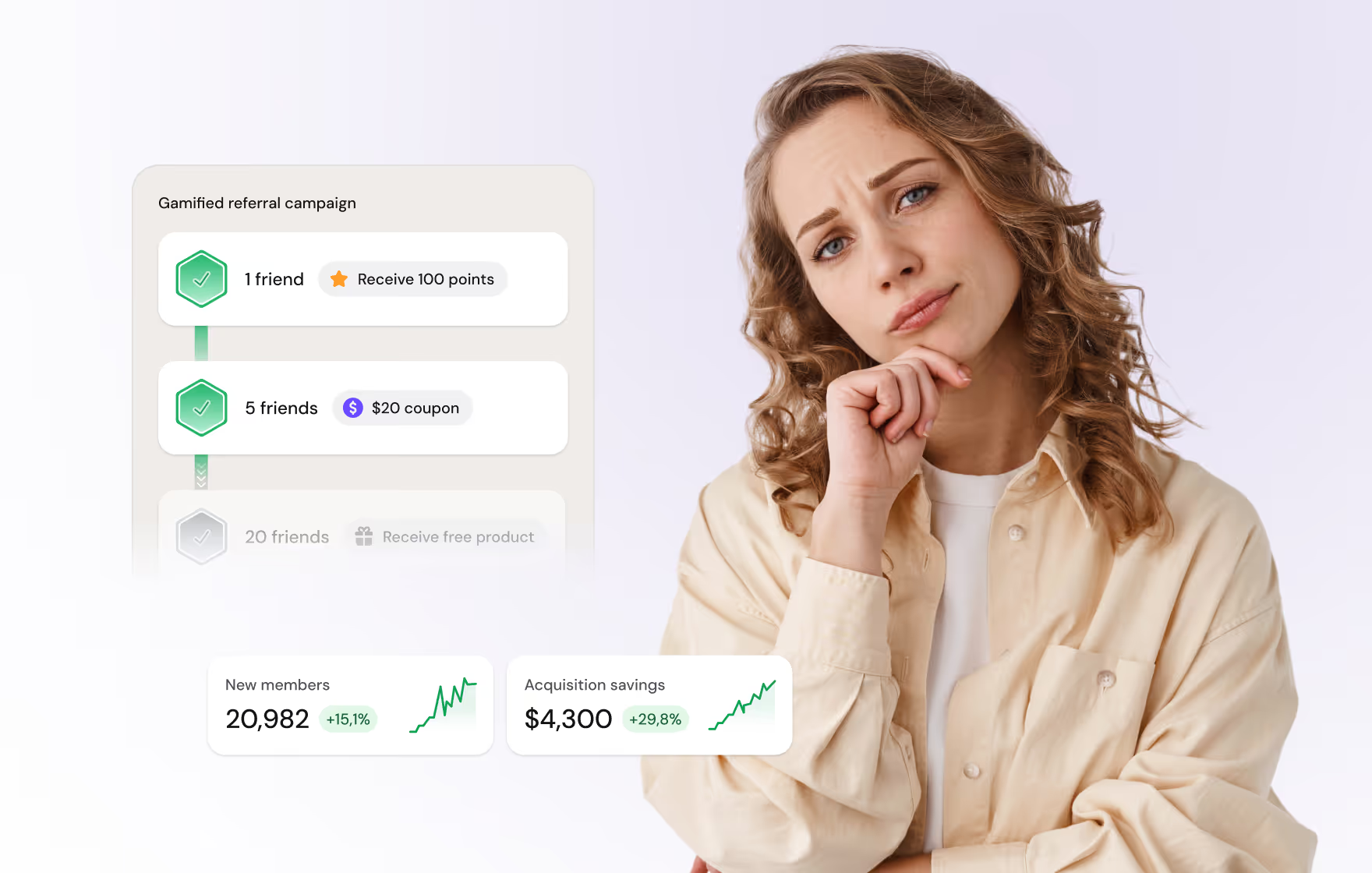
Referral engines, partner co-promotion mechanics, and gamified onboarding all use the existing customer base as a discovery channel.
The economic argument is simple. A referred customer costs whatever you pay the referrer, which for most brands is meaningfully less than paid CAC.
EQUIVA proved that out at €240,000 in saved acquisition cost in the first year of running their referral layer.

What the software has to do here:
The referral software guide covers the capability checklist.
Conversion is where ecommerce loyalty software either touches the checkout flow or doesn't.
The mechanics that move CVR all happen inside a tight window. Tier-progress visibility on the PDP and in the cart. Points redeemable against cart totals (not as separate discount codes). Member-only pricing surfaced before checkout. Gamified challenges that trigger on cart composition.
They share one technical requirement. The loyalty engine has to serve real-time member state to the storefront, with low enough latency that the cart shows current data.
When that works, the lift is measurable. limango ran a challenge specifically for customers with average order values below €100.

AOV on those customers jumped from €66 to €93, a 41% increase, driven by the structured pattern of behavior the challenge design encouraged.
The gamification software guide covers the multi-condition mechanics that make this kind of campaign possible.
Retention is where most ecommerce loyalty programs spend their first eighteen months.
Points encourage second purchases. Tiered structures pull customers up the LTV curve. Frequency challenges turn occasional buyers into regulars.
limango's purchase-frequency challenge more than tripled buying frequency over a three-month window year-over-year, from 2.5 transactions to 7.8.
Most vendors handle points and tiers competently. The differentiation lives in the details that don't get demoed.
Per-SKU and per-segment earning rules let marketing set different earn rates for different products or customer cohorts without writing custom code each time. Without them, every campaign collapses to a flat percentage applied uniformly.
Multi-currency wallets matter the moment a brand operates across markets. They keep each market's points balance, redemption catalogue, and tax treatment separate while rolling up to one member view.
Reconciliation tooling is the capability the finance team cares about most. Points are a balance-sheet liability from the moment they're issued, and software that surfaces outstanding balances and burn rates cleanly saves the controller a quarterly export-to-Excel exercise.
The tiered loyalty program guide walks through tier design. The pay with points guide covers redemption mechanics.
Advocacy is the funnel stage where loyalty stops being a customer-facing program and starts being an acquisition engine in its own right.
VIP gating on product launches, ambassador programs that pay top-tier members to refer, member-exclusive content drops, community mechanics. All of those sit at this end of the funnel.
Sephora's Beauty Insider tier ladder runs the play at the 45M+ member scale, with VIB and Rouge unlocking benefits that pure transactional rewards can't replicate. (Full Beauty Insider teardown.)
What the software has to handle here looks different from the rest of the funnel. Deeper segmentation than transaction count. Content gating tied to member tier. Plug-ins to a community or social layer. The ability to operate across transactional and non-transactional events.
Less measurable than the other three stages, more compounding over time.
Day one rarely needs all four stages running at once. Year three usually does. The software has to be capable of the second case even when the first case is what's launching.
Apps and bolt-on tools usually do one or two stages well and the rest barely at all. Picking software for the stage you care about today caps the others tomorrow.
Most of the confusion in this category comes from lumping fundamentally different software into one bucket. Here is how it actually splits.
None of these are automatically wrong. A small Shopify store running a simple points program does not need a headless engine.
But an ecommerce brand with three or more tech stack components (a CDP, a CRM, and a marketing automation tool, say) will usually outgrow the first three archetypes faster than expected.
The signal you're ready to graduate: you've already written one workaround to get loyalty data where it needs to go.
The headless loyalty software approach is what makes the next phase possible. The broader MACH architecture pattern (microservices, API-first, cloud-native, headless) is where most modern ecommerce stacks are heading.
Members convert better than guests. That much is observable from launch week onwards. What most dashboards can't tell you is whether the program caused the difference or selection bias did.
The questions that matter are not "how many members enrolled" or "how many points issued." Those answers prove the program exists. They don't prove it's working.
The questions a serious ecommerce loyalty program has to answer:
The last one is the question vendors hate. A measurement story without a holdout is a story about correlation, not contribution.
Software that doesn't make holdout testing easy is software you'll defend on faith, not on math.
The 9 loyalty program metrics guide has benchmarks. The redemption rate guide covers the reward-economy question specifically.
The Otto Group ecommerce marketplace runs family Star, a gamified bonus program, across Germany, Austria, the Netherlands, and Poland on a single API-first engine.

Twenty-two million members. Multi-currency wallet stack. A challenge library that mixes transaction-based mechanics (buy three of X) with interaction-based ones (log in five days running).
The headline outcome (+41% AOV on the segmented challenge) gets quoted in decks.
The structural outcome is the four markets running on the same engine, which was an architectural call the team made at procurement, not a feature unlocked later. (Full case study.)
The German home décor brand sits at the opposite end of the funnel from limango.
Where limango's flagship outcome is conversion, EQUIVA's is acquisition. €240,000 saved in customer acquisition cost in the first year of running a gamified referral layer, with buyer frequency doubling on the side.

The mechanic is a textbook two-sided referral program. The difference is that it lives inside the loyalty engine, attribution and economics in one place, instead of bolted on as a separate stack item. (EQUIVA case)
A different software stack from the other two (Sephora runs the program in-house). The design choice that matters is universal.
Beauty Insider treats tier progress as a real-time signal at the cart, not a quarterly status email.
The 45M+ member program runs on the principle that loyalty information has to be visible to the customer at the moment of decision. That puts the latency requirement on the software, not on the marketing team.
The thread through all three: the software was sized to run at every funnel stage, with the data the funnel actually needs.
Plenty of teams pick the right loyalty software and still end up with the wrong outcome. Four common pitfalls explain most of those misses.
The cheapest mistake.
The software a team picks for "we want a points program" rarely survives the moment marketing decides to add tiers, gamification, multi-market, or a referral loop.
The fix is to scope the software against the year-three roadmap, not the 90-day plan.
Every loyalty vendor demos points, tiers, and referrals well. That part of the category was solved a decade ago.
The differentiator sits underneath. Engines that expose every mechanic through a clean public API integrate with the rest of the stack without negotiation.
Engines that hide the API behind "professional services engagements" don't.
If the vendor isn't showing API docs by demo two, you're being sold a UI.
Integration scope is the line item that gets underestimated more than any other in loyalty implementations.
The program design is fine, the software is fine. The integration list turns out to be twice as long as the SOW assumed.
By month four, the team is paying for a platform that's only firing two of its mechanics, because the others depend on data the integration backlog hasn't shipped yet.
Vendor selection should treat integration depth (number of pre-built connectors, openness of the API, behavior of the events stream) as a top-three criterion, not an afterthought to sort out post-contract.
The integration playbook covers what good looks like.
A loyalty module inside an all-in-one marketing suite is not the same product as a dedicated loyalty engine.
The module shares the suite's data model, the suite's roadmap, and the suite's pricing leverage.
Some brands deliberately consolidate to a suite. Others end up there by accident, then discover three years in that the loyalty layer can't do half of what they need.
The build vs buy decision frames the trade-off cleanly. Watch for loyalty fraud too, since modules inside a suite often have weaker controls than purpose-built engines.
Every mechanic in this piece (referrals, gamified challenges, tier visibility, redemption at the cart, advocacy gating) shares one technical prerequisite.
The loyalty engine has to be addressable in real time, by every other system in the ecommerce stack, with state that's accurate at the moment of the call.
That's an architectural pattern, not a feature. Software either has it or it doesn't.
The patterns that get there are well-trodden at this point. API-first as the engine's default surface area. Headless deployment that keeps the business logic decoupled from any single front-end. A composable mechanic library the marketing team can configure without dev tickets.

None of that is exotic. All of it is hard to retrofit if the original software wasn't built for it.
The numbers vouching for this approach come from real implementations.
Open Loyalty's integration with Bloomreach (a marketing automation platform) drove +23% AOV and +42% transaction frequency once the loyalty engine and the activation layer started talking in real time. (Full integration case.)
On the scale end, the Open Loyalty + AWS scaling case documents how the engine handled 1,500+ concurrent API calls across a multi-market rollout.
Two named teams who'd attest. Fritze von Berswordt, Managing Director at EQUIVA:
"We used Open Loyalty pre-built modules, applied the loyalty mechanics via API to our tech stack and focused fully on the customer experience."
Verena Pflug, Business Owner at limango GmbH:
"The family Star program is the umbrella of all of our different services. We use it to communicate with our customers and engage them with the limango platform."
Both quotes describe the same outcome from different angles. When the engine handles the mechanic-level work natively, the team's hours go into experience design instead of integration plumbing.
That's the real return on the architectural decision.
For the longer-arc economics of this stack, the enterprise loyalty CLV guide is the deeper read.
Software that fits a year-three program isn't a different category from software that fits a year-one program.
Year-three software has more API surface area, more integration headroom, more mechanic flexibility. Year-one software is what's left when those things are stripped out and the price comes down.
The trap is that the year-one software is genuinely better for a year-one program. Cheaper, faster to ship, less to learn.
The decision only shows its real cost when the team starts asking the engine to do work the engine wasn't built for, which usually happens around the time the second mechanic gets added.
The fix isn't to over-buy the platform on day one. It's to size the platform against the program a year-three roadmap describes, even if year one only ships a fraction of it.
That's the procurement conversation almost no team has, and it's the only one that prevents the year-three rebuy.
Open Loyalty's loyalty architects walk teams through this exact conversation. Book a call. The pillar buyer's guide covers the wider software category.
eCommerce loyalty software is the system that runs a retention program on an online store.
It manages points, tiers, rewards, referrals, and gamification mechanics. It connects those mechanics to the store's checkout, customer data, and marketing stack.
The best systems sit inside the ecommerce stack rather than beside it.
At minimum: flexible points logic, tiered memberships, referral management, reward and coupon handling, and analytics.
For mid-market and enterprise brands, add multi-wallet support, gamification mechanics (challenges, badges, games of chance), multi-market capability, and deep API access to every mechanic.
For plug-and-play apps, installation is a marketplace click.
For API-first engines, integration happens through pre-built connectors or custom API calls. That means any ecommerce platform (including headless setups on commercetools or custom stacks) can work.
The trade-off is depth. App-level integration is fast but shallow; API-level integration takes longer but supports the full mechanic set.
A loyalty app is usually a closed system inside a single ecommerce platform.
Ecommerce loyalty software, in the platform sense, is an engine that integrates across the full tech stack and supports complex program mechanics.
The app is the starter. The software is the long-term home.
The signs are consistent.
You've built at least one workaround to get loyalty data into another system. Your program roadmap includes mechanics your current app does not support. Or you're planning multi-market expansion.
Any of those three is the cue.
In practice: data isolation, security certifications (ISO 27001, ISO 9001, OWASP testing), and the ability to handle high-volume concurrent API calls.
Add multi-market support and a delivery and support model that matches enterprise rollouts.
The enterprise loyalty software overview covers what this looks like in practice.
Get a weekly dose of actionable tips on how to build and grow gamified successful loyalty programs!